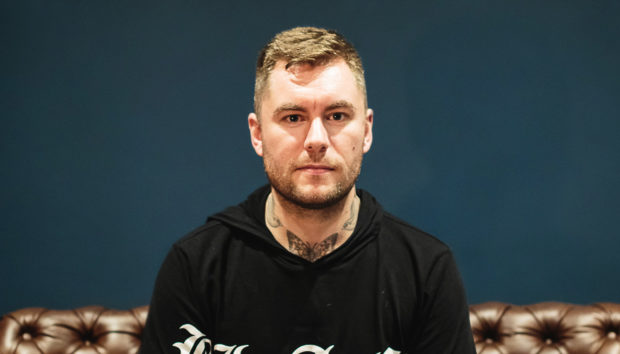



Chicago-based producer and DJ Kice has built his name on a rare combination of cultural fluency and club-focused precision. His latest single “Al-Ain,” out now on Treble Recordings, marks a pivotal point in his sound. It’s a confident blend of Mediterranean and Arabic instrumentation with modern house grooves.
Drawing from his Jordanian heritage, he layers the expressive tones of the oud, nay, and qanun over deep, rolling rhythms, crafting tracks that feel grounded in tradition while built for the dancefloor.
Central to this process is Native Instruments’ Guitar Rig, a tool Kice uses to shape and integrate live-recorded instruments into polished electronic arrangements. From subtly enhancing the resonance of an oud phrase to giving percussion a warm, analog edge, Guitar Rig plays a key role in uniting his acoustic and electronic elements.
Jump to these sections:
- How heritage shaped Kice’s sound
- Recording and sampling traditional instruments
- Using Ozone to blend traditional and modern sounds
- Progressing past mashups into original tracks
- How tools like Guitar Rig democratize production
- Why cultural respect matters in production
For Kice, it’s more than an effect suite as much as it’s a bridge between worlds that allows him to honor his roots while pushing his productions into fresh territory. So let’s dive into it.
What first drew you to blending Mediterranean or Arabic instrumentation with house music?
It was really organic, almost a subconscious pull at first. Growing up as a Jordanian-American in Chicago, my home was always filled with the sounds of Amr Diab, Omar Abdullat, Najwa Karam, Umm Kulthum, Fairuz, and Samira Tawfiq.

Simultaneously, I was immersed in Chicago’s legendary house scene. For a long time, these two worlds existed somewhat separately in my artistic life. But as I evolved as a producer, I started feeling this deep urge to explore how I could fuse them and be more authentic to myself. It was about truly building a sound that represented me, that celebrated both my roots and my passion for electronic music.
The melodic complexity of Arabic music layered onto a house four-on-the-floor creates something truly unique and deeply emotional. That potential for a fresh, authentic sound is what drew me in.
What kinds of instruments are you sampling or recording that represent your Jordanian heritage?
I’m consistently working with a range of traditional instruments that carry the essence of my heritage. The oud is a big one – its rich, resonant tones are so fundamental to Arabic melodies. Then there’s the nay, a type of flute, which has this incredibly haunting and expressive quality. For percussion, I’m often recording tabla, focusing on intricate rhythms and distinct percussive textures.

Beyond that, I’m exploring instruments like the qanun for its unique melodic possibilities. And of course, vocals are paramount. Finding and working with authentic Arabic vocalists who can convey the raw emotion of the lyrics is crucial.

Sometimes I’m sampling old recordings for texture, but increasingly, I’m keen on recording live instrumentation to get that organic feel directly into my productions.
How have plugins changed the way you look at the intersection between heritage and genre?
When I use Ozone, it’s incredibly powerful for the pre-final shaping and testing of my tracks. I can apply its Mastering Assistant to ensure those rich heritage elements, along with my synths and drum machines, blend cohesively and translate beautifully across all listening systems.

The goal isn’t to make those traditional sounds purely electronic in their origin, but to make them fit seamlessly into the overall electronic soundscape, ensuring they have the presence and clarity they deserve. This capability allows me to turn a master much quicker to test while on the go and live.
Has your approach changed since your earliest attempts at merging these two sound worlds?
Oh, absolutely. My approach has evolved significantly. In my earliest attempts, it might have been more about simply layering an Arabic sample over a house track as a mashup. It felt a bit disjointed sometimes, like two separate pieces forced together.

Now, it’s much more about integration and synergy. I’ve learned that it’s not enough to just drop an Arabic loop in. You have to understand the emotional and melodic context. My process now involves deconstructing the essence of Arabic musicality, the maqams, the specific rhythmic patterns, and then building the electronic elements around them, or even letting them guide the electronic composition.
It’s a back-and-forth conversation between the two elements, aiming for a seamless blend where the traditional sounds feel like they were always meant to groove with a four-on-the-floor beat.
Do you think tools like Guitar Rig help democratize tone shaping for artists without full analog setups?
Without a doubt, yes.
Not every artist, especially emerging ones or those focused on electronic production, has access to a vintage amplifier collection, a full pedalboard, or a high-end analog studio. Guitar Rig, and similar software, provides an incredible array of authentic amp models, cabinets, and effects that can transform any input signal.

For me, that’s crucial. I can record a raw violin, sax, vocals, or even a synth line, run it through Guitar Rig, and dial in tones that give it a shimmering texture that would otherwise require an expensive analog setup. It really levels the playing field, letting creativity and sonic vision be the main drivers, rather than just budget.
What’s one thing you wish more producers knew about working with ethnic instruments in electronic production?
I wish more producers knew that it’s about respectful immersion, not just superficial sampling. Don’t just grab a random loop because it sounds “exotic.”

Take the time to understand the cultural context, the emotional depth, and the musical theory behind the instrument or vocal you’re using. Learn about the maqams or the specific rhythmic patterns. When you approach ethnic instruments with genuine respect and a desire to understand their soul, you move beyond mere decoration.
You can then truly integrate them, letting them inspire the entire track, allowing their unique character to drive the melody, harmony, or rhythm. It elevates the production from a simple beat with a “world music” overlay to a truly authentic, powerful, and culturally rich piece of electronic music. It makes the statement more profound.
Wrapping it all up
Kice’s approach proves that blending cultural heritage with modern house production is about authenticity, intention, and technical precision.
By putting Guitar Rig at the center of his process, he’s able to shape tones that honor the organic character of Mediterranean and Arabic instruments while giving them the punch and presence needed for today’s dance floors.
With “Al-Ain,” he’s not only redefining his own sound but also carving a lane for producers who want to explore their roots without compromising on club impact.
Related articles
-
An update from Nick Williams, CEO of Native Instruments
I want to share a direct update on the restructuring process underway here at Native Instruments. Business continues as usual…
-

NI producer spotlight: Women’s History Month 2026
Discover more than 30 women and nonbinary producers – including WondaGurl, Arca, and Tems – who are defining the modern…
-
Learn how Andre Samuel and Daylight kept Mon Rovîa’s Bloodline sounding natural and clean
Learn how production duo Daylight and Andre Samuel used iZotope RX and Native Instruments tools to capture the organic soul…
-

5 of the best vocal plugins for modern music production
Unlock the power of the human voice. Explore five distinct vocal plugins designed to bring emotion and character to every…
-
Speed, melody, and instinct: Will Bates on composing for streaming with Kontakt
Will Bates explains how Noire and Kontakt helped him score 'The Better Sister' with speed, emotion, and precision for Prime…
-

Best drum synths for electronic music
Discover the best drum synth VST plugins for electronic music. From professional sound design in Massive X to creative layering…
-
Richie Hawtin: deconstructing the dancefloor with Traktor
Go behind the scenes with Richie Hawtin to see how he uses Traktor, analog mixing, and live sequencing to create…
-

How Nova Wolf finds humanity in loudness with Ozone
Nova Wolf explains how iZotope Ozone helped him master Nomad Tapes: Africa with warmth, emotion, and cohesion, balancing intensity with…