
Composer Tom Schraeder’s score for Vicious, the new Paramount+ psychological horror film starring Dakota Fanning, stretches tension like a live wire. Long before cameras rolled, he began scoring directly from Bryan Bertino’s script, writing the main themes on a 64-piece orchestral scale before pulling everything inward.
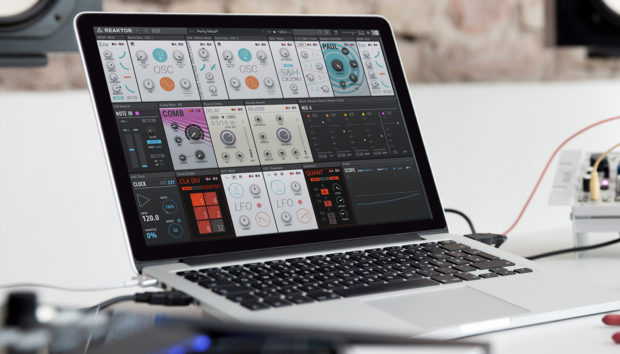
The result was something raw and unnerving, full of creaks, metallic groans, and human breath. Schraeder’s own handmade “Terror Box” became the heart of that sound – a wooden instrument built from scraps. That, alongside Native Instruments’ Thrill, helped shape the score’s supernatural edge.
With Thrill, Schraeder found a way to translate anxiety into movement.
Its evolving textures and hands-on XY-axis control made it feel alive, mirroring the instability of Fanning’s character as she slips further into fear. Used alongside live instruments and experimental recordings from collaborators like Clive Deamer (Radiohead, Portishead) and Stan Harrison (David Bowie, Bruce Springsteen), Thrill became the invisible pulse running through the music, which is a bridge between the organic and the otherworldly.
Jump to these sections:
- Creating musical tension from the script
- Introducing Thrill to heighten the supernatural layer
- Using Thrill for sound design
- Balancing orchestral and synthetic tension
- Advice for producers scoring horror
The score breathes, panics, and collapses in on itself, as if haunted by the very box at the center of the film’s story, so let’s talk about how Tom works his magic.
Create your own haunting scores and atmospheres with Thrill:
Vicious has such a suffocating sense of tension. When you started scoring from the script, what kind of emotional atmosphere were you trying to create?
When I started scoring Vicious from the script, I began by writing the central themes first, which were pieces like “Polly Theme,” “Vicious Theme,” and “Hour Glass.”

Originally, I wrote for a 64-piece orchestra, but during that process, I also started building what would become the “Terror Box.” It started from an old cigar box guitar. I ripped out the bottom, built a new wooden box roughly the same size as Polly’s box in the film, and added contact microphones, spring reverb, and hand pedals, along with various springs, rulers, and bits of metal that could be bowed or struck to create unsettling, percussive sounds.

As the process evolved, I found myself using anything Dakota interacted with in the film as inspiration for sound. I wanted to replicate her anxiety spiral sonically, by mimicking the way tension can build from seemingly ordinary noises around you.
Personally, my own anxiety often manifests through sound, which is small noises stacking and building until they become overwhelming. I leaned into that idea, where cigarette packs became drones, wine glasses became piercing frequencies, and the Terror Box tied it all together into a physical manifestation of unease.
I combined all of these elements into the orchestra, the handmade instruments, and the found sounds. I started painting the picture of Vicious: a claustrophobic, suffocating sonic world where the music itself feels like it’s closing in on you.
I created music intended for the chest and the head, rather than the ears.
Pro tip from Tom Schraeder: Humanize the plugins. When using a plugin, make it feel and sound like a human. Especially in horror, realism is everything. If it feels too mechanical, it personally pulls me out of the story. Control the plugin, but don’t let it control your sound. Don’t be afraid to leave in minor imperfections, as those little human touches are often where the magic lies.
What drew you to using Thrill as a foundation for shaping that tension?
The organic, real-life tension I had already built needed touches of something otherworldly. Something that could represent the malevolent, outside force of the box itself. That’s where Thrill came in. It allowed me to introduce a supernatural layer that contrasted Polly’s inner, psychological spiral.
Since most of the score is rooted in her internal world, Thrill became that perfect tool to occasionally push beyond reality, to blur the line between what’s real and what’s not when the story demanded it.

What I loved most about Thrill was its versatility, especially the XY axis feature. It gave me the sense that I could shape the sound in real time, that it was something controlled by a human rather than just allowing the computer to control the piece.

That human element was crucial. I wanted the rises and swells to feel alive, to breathe, and to respond as if they had intention. That’s exactly why I gravitated toward Thrill, as it let the music feel intelligent and unpredictable, yet deeply human at its core.
Pro tip from Tom Schraeder: Reclaim rhythm. Something about today’s way of making music in the box (no pun intended) has made us hyper-fixated on metronomes, and I’m definitely guilty of that too. In doing so, we sometimes forget the natural connection between the human spirit and rhythm. For Vicious, we purposely went off the click at times to stay true to the physicality of the characters’ unraveling experience, while embracing the natural tension that comes from unsteady time.
Did you treat Thrill more as a sound design tool or as a traditional instrument during the process?
Thrill can absolutely be used as a traditional instrument, and I’ve used it that way in the past, but for Vicious it functioned more as a sound design tool. It became something that complemented the organic sonic palette we’d already built. We had spent so much time crafting drones and textures out of live, organic sounds, extended techniques, and objects Dakota interacts with in the film. Thrill was the perfect way to amplify those supernatural layers as the story evolved.

What I loved most about Thrill was its versatility, especially the XY axis feature. It gave me the sense that I could shape the sound in real time, that it was something controlled by a human rather than just allowing the computer to control the piece.

That human element was crucial. I wanted the rises and swells to feel alive, to breathe, and to respond as if they had intention. That’s exactly why I gravitated toward Thrill, as it let the music feel intelligent and unpredictable, yet deeply human at its core.
Pro tip from Tom Schraeder: Reclaim rhythm. Something about today’s way of making music in the box (no pun intended) has made us hyper-fixated on metronomes, and I’m definitely guilty of that too. In doing so, we sometimes forget the natural connection between the human spirit and rhythm. For Vicious, we purposely went off the click at times to stay true to the physicality of the characters’ unraveling experience, while embracing the natural tension that comes from unsteady time.
Did you treat Thrill more as a sound design tool or as a traditional instrument during the process?
Thrill can absolutely be used as a traditional instrument, and I’ve used it that way in the past, but for Vicious it functioned more as a sound design tool. It became something that complemented the organic sonic palette we’d already built. We had spent so much time crafting drones and textures out of live, organic sounds, extended techniques, and objects Dakota interacts with in the film. Thrill was the perfect way to amplify those supernatural layers as the story evolved.

One of my favorite things about Thrill is how seamlessly it blends with other instruments and layers. Whether stacking its choirs or string textures with elements like the waterphone, it always found its place in the mix. It became an instrumental texture for building rises, sustaining tension, and even creating smooth transitions between scenes.

As a horror composer, I’d honestly say there’s life before Thrill and life after Thrill. It not only enhances the creative process but also saves a ton of time while still feeling musical and alive.
Pro tip from Tom Schraeder: Remain authentic. Just because our job as composers is to bring someone else’s vision to life doesn’t mean we can’t connect authentically as artists. I often hear composers say they can do any genre, but for me, it’s more important to create from a place that feels genuine and emotionally honest.
How did you balance orchestral and synthetic elements throughout the composition process?

We maintained the balance between orchestral and synthetic elements by making sure everything felt as organic and intentional as possible from the start. Even when using plugins as textures, the goal was always to keep the human element at the forefront. The more synthetic sound design layers were saved for when the story began to venture into its more supernatural territory.
When it came to Thrill, I found it worked best once we wanted that wall-of-sound to live somewhere between rustic classical and contemporary chaos, with touches of avant-garde jazz dissonance woven in. That blend between the orchestra: the woodwinds, strings, and piano, and the more experimental elements like the Terror Box or the textural layers from Thrill created this sonic tug-of-war between grandeur and claustrophobia.
Everything was built around the themes and their musicality until it was time to deconstruct them and let the melodies unravel as the story and Polly’s psyche fractured. At just the right moments, we’d reintroduce fragments of those themes to mirror her emotional state and tie it all back together.
Pro tip from Tom Schraeder: The picture doesn’t lie. No matter how much you love a piece of music, if it’s not working with the picture, just start over. Trust the visuals.
What advice would you give to younger composers using Thrill or similar libraries for the first time in psychological or horror contexts?
For younger composers using Thrill, or any similar library, my biggest advice is to explore it fearlessly, and remember that horror doesn’t always have to be scary. Dive into the psychological, emotional, and even beautiful side of the sounds. Thrill is incredibly rich in texture and tone. There’s real beauty in its darkness if you treat it thoughtfully. It has this great balance of low and high frequencies, leaving the mid-range open for whatever emotion the scene calls for.
I think a common misconception is that horror music needs to be terrifying at all times. Maybe that works for some films, but my scores tend to focus more on when life itself becomes horrific, which can include receiving life-altering news, spiraling with anxiety, or facing grief.
Real life doesn’t come with a Halloween theme or Psycho stabs (though it would be pretty cool if it did – I love those scores). In reality, those moments feel more like amplified dramatic tension leading to mourning. I’ve found it far more powerful to treat horror as high drama or suspense, and to earn those terrifying crescendos rather than live in them constantly. Thrill makes that balance possible. It offers as much beauty as it does dread, and that contrast is where I fell in love with it.
Scoring horror, or any genre, comes down to respect. Respect for the visuals, the performances, the audience, and most of all, authenticity to the story. I’m paraphrasing here, but the legendary Bonnie Hunt once told me, “Scoring is more than music. It’s the final rewrite.” That’s stuck with me ever since.
You need to know the script as deeply as an actor. Serve the story, don’t write your own. Of course, if a director wants a full-blown horror soundscape from start to finish, I’m all in, as that’s part of the job too. In this industry, there’s no room for ego. We’re here to serve the director’s vision.
Thankfully, a plugin like Thrill offers both beauty and terror, and that duality is where the real storytelling lives.
Pro tip from Tom Schraeder: Explore accidents and reshape them into something new. Perfection can kill the spark that makes music feel alive.
Wrapping it all up

Talking with Tom Schraeder gave us a look inside the mind of someone who sees horror as something deeply human. His approach to Vicious shows how much care and intent can live inside a film score when technology serves emotion instead of replacing it. The way he blends handmade instruments like the Terror Box with cinematic tools like Thrill reminds us that the best tension comes from contrast, precision meeting instinct, structure meeting chaos.
Thanks to Tom for sharing his time and process. His work on Vicious is a reminder that plugins can be more than production tools. They can be instruments of storytelling when treated with patience and imagination
Explore the dark side of sound design and composition with Thrill:
Related articles
-
How Massive helped Johnny Gorillas shape two creative worlds
Johnny Gorillas shares how mastering Native Instruments Massive shaped his solo work and his work with mono sky, creating consistency…
-
The best sound design plugins from Native Instruments
Discover the best sound design plugins for music, film, and games, including top synths, effects, and creative tools from Native…
-

Taming the monster: behind the soundtrack of K-Pop Demon Hunters
Discover how GRAMMY-nominated engineer Curtis Douglas and producer Lindgren used iZotope Ozone, RX, and Kontakt to craft the high-impact, polished…
-

The best DJ effects: a complete list for beginners and pros
Discover the best DJ effects for every mix, from essential filters and delays to creative tools like the Beatmasher. Learn…
-
Weird by design: HAAi on the limitless potential of Absynth 6
Discover how the Australian artist HAAi uses the new engine in Absynth 6 to create layered atmospheres and immersive soundscapes…
-
$0 to pro studio: your first 5 music production tools that replace $3,000 of gear
In this blog, you’ll learn how to replace hardware gear with VST plugins and get a cheap pro home studio…
-
Noha on groove, texture, and using Guitar Rig to shape emotion
Italian producer Noha explains how Guitar Rig, modulation, and subtle distortion shape his minimal yet emotional sound in “The Place.”…
-
Junaco on DIY recording, Sonic Ranch, and the subtle power of RX
Junaco share how RX helped shape In Motion, keeping the album’s warmth and intimacy intact while refining every detail of…