
Denver-based trio Hostage Situation has released their debut album Hostile Frequencies, a 21-track project that cements their rise from local fixtures to national headliners. The record captures the full scope of their approach, blending heavy dubstep and riddim with bass house, vocal-driven collaborations, and more exploratory textures.
Kontakt plays a central role in shaping this album’s identity. Across tracks like The Device, the group leaned on libraries such as Ashlight, Straylight, and Pharlight to build atmospheric tension before unleashing explosive drops. Paired with tools like Playbox, Raum, and Guitar Rig, their workflow shows how Native Instruments’ creative suites can be used to expand sound design possibilities in heavy electronic genres.
Jump to these sections:
- The role of Kontakt in The Device
- Hostage Situation’s creative process
- Unexpected Kontakt instruments for aggressive music
- Live versions versus studio versions
- Kontakt tricks for sound design
- First steps for using Kontakt in heavy genres
We spoke with Hostage Situation about how Kontakt informs their writing process, the balance between live and studio arrangements, and the creative habits that drive their evolving sound.
All of the instruments and effects mentioned in the interview are available in our 360 Plus and Pro subscriptions.
Let’s start with The Device. What role did Kontakt play in shaping the tension and release of that track?
Kontakt helped shape a lot of the tension in this track right off the bat in the intro, using libraries like Ashlight, Straylight, and Pharlight.

We were able to create soundscapes that instantly transport you into a track’s vibe and space. Personally, we think there’s nothing more important than the vibe that a track can give you. You can have the craziest sound design in the world, but without proper context and groove, it can get lost very quickly. Even beyond this track, if you take a listen to some of our other songs, you can definitely hear a lot of these atmospheric Kontakt libraries in use.
We especially love it for its versatility since you can go from very dark and eerie cave-like atmospheres all the way to very bright, cheery, and almost quirky textures.
Can you walk us through some of your creative process? What comes first, the intro or the drop?
Our process is pretty random. Sometimes we’ll start with an intro, and sometimes we have a drop idea that we work backwards from. Whatever the starting point, we more often than not begin with a story or a location that we want to make a track about.

Ideas can come from anywhere, but having a theme to go off of helps a lot – whether it be some big moment in your life with strong emotions, or something as simple as making a song about a cat.
There’s a lot of storytelling you can do with sound design when you have a theme as a jumping-off point. A perfect example is this track – “The Device.” Initially, the project name was “Event Horizon,” referencing black holes. After creating so many elements of the song, we renamed it a few times before landing on “The Device.” That came from thinking of a monologue that could go through the intro of the track.
What are some of the unexpected Kontakt instruments or libraries you’ve found useful for aggressive music?
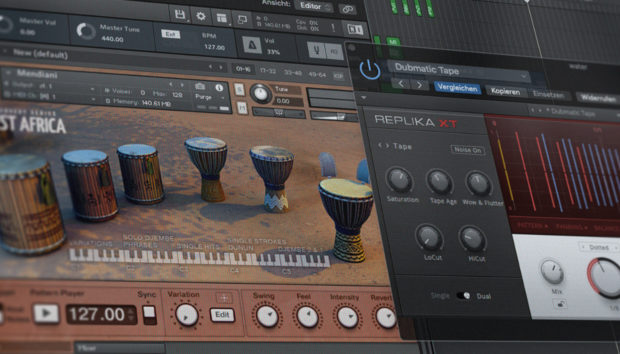
Something that might be unexpected is the use of Playbox. There are a lot of really cool sounds in there that sound great out of the box, but they can also be expanded on through post-processing, especially when modulating time through resampling or re-time plugins.

On this one track, we resampled the Cute Piano preset, and I really like Playbox for the sequencing of a lot of these patches. It can inspire new riffs you might not have thought of in the first place, and even then, you can bounce that to audio and chop it up to create reverse swells into main melodies.
There’s a lot of ear candy that you can achieve with Playbox that would otherwise take me an embarrassingly long time to achieve.
Do you approach live and studio versions differently, or are they basically the same arrangement?
When it comes to studio versus live versions, I personally like the live versions since they give you more freedom. For instance, you can have longer intros and build more of the theme that the track is about. The more tension you have built, the more the drop pays off.

Our sets have become very eclectic, and we play a wide range of genres. We like to mix things up, so we put unexpected moments throughout the set. Having a kind of psychedelic dubstep track after around 30 minutes of heavy tear-out dubstep lets you elongate the intro to reset the vibe. That makes people in the audience realize they’re about to venture into something new.
The crowd reaction really shows how much context matters. Changing things like this can seriously impact big payoff moments.
What’s a recent Kontakt-based trick or habit that’s leveled up your sound design?
Recently, I’ve gotten super into resampling and trying to destroy the audio as much as possible.

A lot of the libraries we use, such as Ashlight, Straylight, or Pharlight, can be resampled and stretched into much weirder EDM-type sounds that have such raw character.

On top of that, I’ll also use other plugins to drive home a new sound. Whether that’s using Raum to give space to the sound or, my personal favorite, running resampled audio through Guitar Rig for unique distortion and saturation that gives breath to a whole new palette of sound.
Finally, what’s the first thing you’d tell a producer trying to use Kontakt in heavier genres like dubstep or bass?

I’d say Kontakt is more of the seasoning than the main dish. By utilizing real instruments within Kontakt and more atmosphere-based libraries, you can contextualize all of the heavy dubstep elements within a space and a theme. That really elevates your tracks. I like listening to a lot of songs for reference, especially when it comes to ear candy, since it’s one of the most subjective parts of writing a song.
Through those references, I immediately get into a bunch of Kontakt libraries to explore new presets I might not have thought to use, or unconventional uses for effects plugins. For instance, the Guitar Rig trick I mentioned earlier – if I’m trying to distort a bass sound, your first thought probably isn’t to run it through a guitar amp emulation. But with its onboard effects, it opens up a whole new world of manipulating sounds.
Wrapping it all up
Hostage Situation’s debut album, Hostile Frequencies, highlights how a trio can take diverse influences and shape them into a cohesive identity. Their use of Kontakt, from atmospheric libraries to Playbox sequencing, shows how producers in heavy electronic music can expand their sound palette without losing intensity.

The interview reveals a process driven by themes, stories, and experimentation. From resampling and stretching audio to running Kontakt instruments through Guitar Rig, their workflow demonstrates how Native Instruments tools integrate across both creative and technical layers of production.
With Hostile Frequencies released and their national tour underway, Hostage Situation has proven themselves as a forward-thinking act capable of translating studio experimentation into a live experience. Their growing reputation reflects the precision and vision that define this debut.
Related articles
-
Speed, melody, and instinct: Will Bates on composing for streaming with Kontakt
Will Bates explains how Noire and Kontakt helped him score 'The Better Sister' with speed, emotion, and precision for Prime…
-
Best drum synths for electronic music
Discover the best drum synth VST plugins for electronic music. From professional sound design in Massive X to creative layering…
-
Richie Hawtin: deconstructing the dancefloor with Traktor
Go behind the scenes with Richie Hawtin to see how he uses Traktor, analog mixing, and live sequencing to create…
-

How Nova Wolf finds humanity in loudness with Ozone
Nova Wolf explains how iZotope Ozone helped him master Nomad Tapes: Africa with warmth, emotion, and cohesion, balancing intensity with…
-
How DJ T-1000 keeps Detroit hands-on with Maschine
DJ T-1000 explains how Maschine fuels his Detroit-driven workflow, bringing focus, rhythm, and hardware energy to his new EP Ghosthack.
-
Inside the spectral world of Oscillarys: a deep dive with Ocean Swift Synthesis
From Eurorack loops to vintage vocals: Ocean Swift shares how they built Oscillarys for motion and why they’ve moved fully…
-

DNKLE turns emotion into energy with Pharlight
DNKLE details how Pharlight helped him turn raw intensity into controlled soundscaping on his latest single, “Pressure,” from GITA Recordings.
-

Behind the bounce of Millennium Hip Hop: a conversation with Snipe Young
Get production tips from GRAMMY-winner Snipe Young. Discover how to capture the legendary Virginia Beach sound with the new Millennium…