
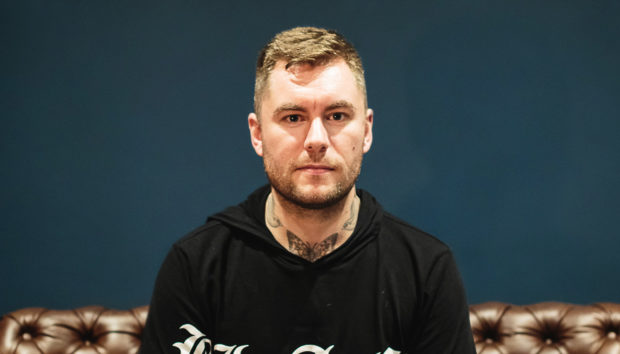



Dutch producer Dela Utca has been steadily carving out a reputation for blending electronic textures with the warmth of live instrumentation. His latest single, “In The City,” released on Soave, captures that balance with precision, pairing expressive guitar work and a chill dance pulse with the emotional honesty of his songwriting.
Behind his sound lies a hybrid workflow built around Kontakt, which anchors his songwriting process and bridges acoustic and digital worlds. Using instruments like The Gentleman, 40’s Very Own Keys, Ethereal Earth, and Session Guitarist Strummed Acoustic, Dela Utca brings a tactile, organic edge to modern electronic production.
In this conversation, he shares how Kontakt has become a creative foundation, how he shapes emotion through sound choice, and why he believes the future of music production is fully hybrid.
Jump to these sections:
- Starting a new track
- Choosing between Kontakt and synths
- Kontakt’s role in Dela Utca’s productions
- Hearing sampled instruments in the mix
- Common mistakes in hybrid production
- Looking ahead to a hybrid future
Explore instruments and powerful sampling capabilities with Kontakt to shape your own songwriting:
When you’re starting a new track, what usually sparks the idea – is it a sound from Kontakt, a vocal, or more of a rhythm first?
My songs always start with a lyrical concept and either an acoustic guitar or a piano. Writing and playing live feel most creative to me, and this approach allows me to switch things up freely. Changing the key, the BPM, and the feel of a song is done in just a few seconds.

When working on the piano, I usually use The Gentleman from Kontakt.
Upright pianos have always been my favorite, and the initial settings, together with some reverb, give the right feeling for me. When creativity doesn’t hit right away, experimenting with sounds can change that. I also like the sounds from 40s Very Own Keys for that. My favorite presets are Styx Bling and 40 Peta Pad. Try them out.
Pro tip from Dela Utca: Experiment with sounds when creativity doesn’t strike right away. Sometimes, steering away from guitar and piano leads to the most interesting chill dance tracks.
Your records balance organic textures with hard-hitting electronic layers. What’s your process for deciding which elements come from Kontakt and which from synths?
The decision between a synthesizer and a sample-based instrument usually depends on my goal for the sound. When it’s something that should feel real, I go to Kontakt (which is sample-based, of course) or record it live.
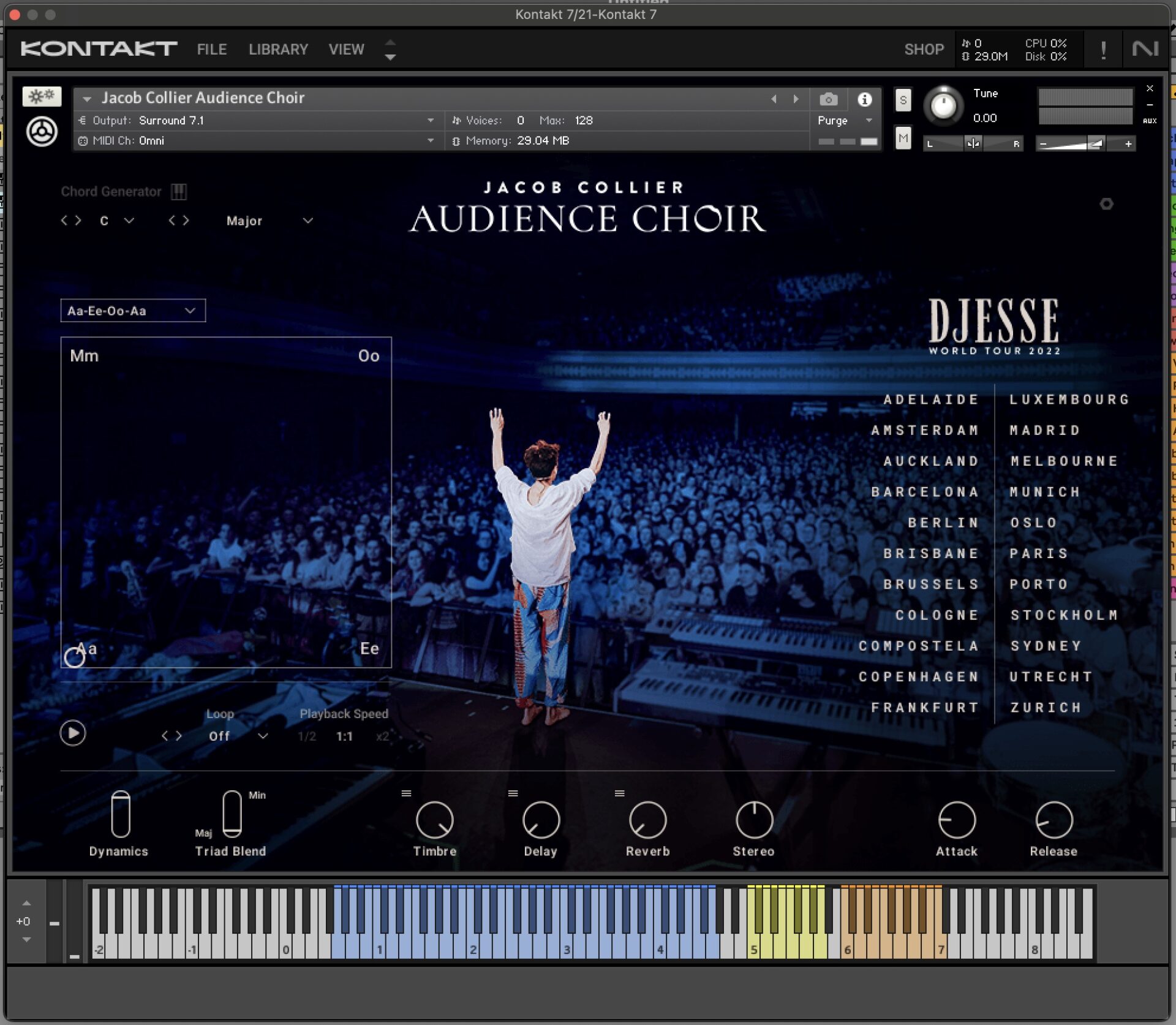
I love Jacob Collier’s Audience Choir, for example, as well as Vintage Organs. These are sounds I can’t really manufacture in a wavetable synthesizer, and even if I could, it wouldn’t sound as good.
When I have a specific non-acoustic sound in my head, I go to a synthesizer because, for me, it’s quicker and easier to shape exactly to taste. You miss out on the happy accidents, but sometimes that’s not what you’re looking for.
Pro tip from Dela Utca: Ask yourself what the purpose of a certain sound is and choose a plugin or instrument to use based on the goal.
What role do Kontakt instruments play in your tracks?
To me, Kontakt really excels when it comes to supporting layers. The lead role usually goes out to either the vocalist or a guitar, which I prefer to play live.

When I started making music as Dela Utca, I made a rack called Dela Utca Atmos with atmospheric sounds from Ethereal Earth. I still use these sounds as supporting layers in my tracks. I’d like to think that makes my songs more cohesive and adds to a signature sound.
Like I said before, most of my guitars are recorded live, but I recently discovered that adding Session Guitarist Strummed Acoustic as an extra layer works really well. It has a different kind of sonic character, and because it’s played very tightly, it adds depth without sounding distracting.

Pro tip from Dela Utca: Combine live recordings with a sample-based version of the same instrument.
Do you think fans notice the “real” textures in your music, even if they don’t know they’re hearing sampled instruments?
I hope so! To me, as a listener, it’s a turn-off when you can clearly hear an acoustic element coming from inside the box.
Luckily, sample-based instruments have gotten so much better over the years – but that also means that there’s no excuse for having a bad-sounding string or brass section.
What’s the biggest mistake you see younger producers make when layering acoustic and electronic elements?
Taking the time to deep-dive into a musical element is very important. Of course, the default sound of The Gentleman is great, but it often takes up too much space in the mix. Tweaking the Color button or the Resonances button makes a world of difference, and that’s the same for almost every sample-based instrument.

Also, not knowing how to arrange something properly is a clear sign of an amateur producer. Try playing it live with a MIDI keyboard and experiment with different voicings. A real musician wouldn’t play something the same way for three minutes. Dive into the MIDI clip and try to humanize it.
Pro tip from Dela Utca: My advice is to keep building throughout the track by increasing velocity and using a wider range of notes.
Looking ahead, how do you see sampled instruments shaping the future of electronic music production, and where do you want to take your sound with them?
Recently, I have been experimenting with sounds while working on my debut album. It gives me the freedom to go more acoustic on a song like “In The City,” but I still love to make the poppy tracks that I’m known for, like “Once In A Lifetime.”

I’m especially curious to see how AI is going to change sample-based instruments. One can only imagine, but the opportunities are endless. The better these instruments get, the easier it will be for artists and producers to start using them.
Pro tip from Dela Utca: The future is hybrid! Dive into the possibilities of both worlds and use whatever works best for you.
Wrapping it all up
Dela Utca’s workflow shows how modern producers can merge performance and technology without losing soul. His use of Kontakt gives him the flexibility to start ideas on real instruments and then expand them into full productions that still feel authentic. Each choice, from the warmth of The Gentleman to the atmosphere of Ethereal Earth and the tight phrasing of Session Guitarist Strummed Acoustic, helps him capture emotion while maintaining clarity.
“In The City” embodies that process. It feels alive because it was built from both worlds, combining the intimacy of acoustic performance with the precision of sample-based sound design.
For anyone looking to explore this balance, Kontakt offers the perfect starting point. Its depth, control, and character keeps the process creative and human. Explore it by diving in today:
Related articles
-
An update from Nick Williams, CEO of Native Instruments
I want to share a direct update on the restructuring process underway here at Native Instruments. Business continues as usual…
-

NI producer spotlight: Women’s History Month 2026
Discover more than 30 women and nonbinary producers – including WondaGurl, Arca, and Tems – who are defining the modern…
-
Learn how Andre Samuel and Daylight kept Mon Rovîa’s Bloodline sounding natural and clean
Learn how production duo Daylight and Andre Samuel used iZotope RX and Native Instruments tools to capture the organic soul…
-

5 of the best vocal plugins for modern music production
Unlock the power of the human voice. Explore five distinct vocal plugins designed to bring emotion and character to every…
-
Speed, melody, and instinct: Will Bates on composing for streaming with Kontakt
Will Bates explains how Noire and Kontakt helped him score 'The Better Sister' with speed, emotion, and precision for Prime…
-
Best drum synths for electronic music
Discover the best drum synth VST plugins for electronic music. From professional sound design in Massive X to creative layering…
-
Richie Hawtin: deconstructing the dancefloor with Traktor
Go behind the scenes with Richie Hawtin to see how he uses Traktor, analog mixing, and live sequencing to create…
-

How Nova Wolf finds humanity in loudness with Ozone
Nova Wolf explains how iZotope Ozone helped him master Nomad Tapes: Africa with warmth, emotion, and cohesion, balancing intensity with…