

Brian McNelis has spent his career at the intersection of music, film, and technology.
From producing the Napoleon Dynamite soundtrack early in his career to helping shape the music of Cyberpunk 2077, his work has bridged the creative, technical, and logistical sides of how music reaches an audience. As President of Lakeshore Records, he has overseen a catalog that has earned 11 Grammy nominations, a Grammy win, and multiple Billboard-charting albums, establishing the label as one of the leading independent soundtrack imprints.
His history with Native Instruments stretches back more than two decades, beginning at NAMM in the late 1990s when he was producing Better Living Through Circuitry. This electronic-music culture documentary captured the first wave of digital production tools entering mainstream use.
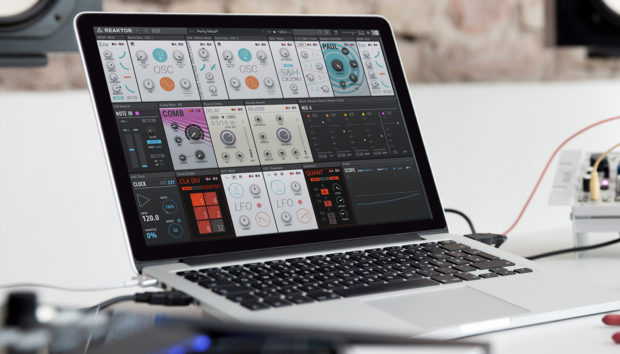
He quickly became an early adopter of Reaktor, B4, Pro 5, Battery, and Kontakt, integrating them into hybrid analog-digital setups that defined the studio workflow of that era.
That long-term relationship evolved from curiosity into infrastructure. Today, McNelis treats NI software not simply as a collection of creative tools but as a communication layer connecting composers, supervisors, and producers.
Jump to these sections:
- First contact with NI and early digital production
- Translating technology into supervision and production
- Shared language between composers and film makers
- The scale and structure of Cyberpunk 2077
- Continuity, infrastructure, and the soundtrack legacy
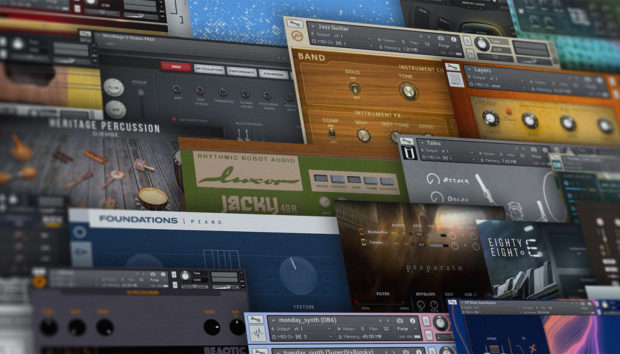
Across hundreds of projects, from independent films to AAA games, Kontakt, Battery, and Komplete remain at the core of how his teams translate creative intent into sound and deliver it efficiently across changing timelines. So let’s have him take us back to the beginning.
You’ve been using Native Instruments for a long time. What originally pulled you into the NI ecosystem and what kept it central to your workflow over the years?
I was first introduced to Native Instruments in the late 1990s – likely 1998 or 1999 at NAMM, though it might have been even earlier. At the time, I was producing the electronic music and rave culture documentary Better Living Through Circuitry with Cleopatra Records. We were obsessed with everything happening in the electronic space and how software was beginning to reshape production and culture.
I’m fairly certain we interviewed a couple of the early NI founders or heads of the company at NAMM that year; if I’m not mistaken, it was Stephan and Daniel. I might even have the original mini-DV source tapes we shot on-site. There’s a whole other movie buried in those tapes that didn’t make the final cut—so much great stuff. I always wished we could have made a second film that went deeper, but as is often the case, time and resources eventually ran out.

Back then, the flagship was likely Generator (which became Reaktor). I also remember the B4 and Pro-5, though the real game-changers for me – Battery and Kontakt – came a little later.
During the production of Better Living Through Circuitry, I was also working with my remix partner, Gregory Butler. He was with Steinberg at the time but eventually went on to help open the first Native Instruments office in Los Angeles. Together, we were commissioned to do work for Hypnotic, a division of Cleopatra Records that was releasing tracks by The Future Sound of London and Paul Oakenfold, alongside compilations featuring The Prodigy and Juno Reactor.
Our moniker was Aleister Einstein – shorthand for “Evil Genius” or “Art Versus Science.” We had a solid studio on Highland in Hollywood built around a Pro Tools 888 rig and a Mackie 3208 mixing desk, all summed to a stereo DAT recorder. I loved that rig. I still wish someone made a modern equivalent to the 3208; the Allen & Heath Zed 436 is probably the closest thing today.

NI software became a core component of our digital setup. The releases of Battery and Kontakt were foundational; they allowed us to transition from a hybrid setup – where we were still leaning heavily on hardware like the Akai S3000 and Kurzweil K2000R – toward a more streamlined virtual workflow.
Processing power was a massive hurdle back then. You had to be incredibly strategic, printing tracks as you went to avoid CPU overloads. It was a constant balancing act: keeping hard drives defragmented to prevent glitches and managing 32 tracks in Pro Tools split across two drives. Looking back, the “mental math” required just to keep a session from crashing was crazy, but we didn’t care. The software was so amazing that we were just excited to see where it was going.
How do NI tools show up in your day-to-day work as a supervisor or producer? For example, Kontakt libraries, effects chains, or specific tools that help you evaluate or shape music choices.
My career has evolved significantly since those studio-rat days. I’ve spent my entire adult life in music and entertainment, and I believe there is immense value in having a background as a musician when you are working in service of musicians.
Even though my time as a professional producer/remixer was a specific chapter, it gave me a shared language. When I’m working with composers today as a supervisor, we speak in terms of keys, progressions, and melody, but we also speak the language of production.

Having a working understanding of the latest libraries allows me to act as a translator between non-musicians (directors or execs) and the artists. For example, I’ve worked with directors who have “sound allergies.” One producer might hear an analog string pad and immediately dismiss it as “too science-fiction” for a drama. Another might recoil at orchestral percussion like timpani or vibes.
In those moments, having the Native Instruments suite at my fingertips is essential. I can quickly sketch an alternative or play different sounds to find what hits the right emotional note without the director needing to know the technical terminology. We just play the sounds until we find the feeling.
Today, that sorcery fits on my MacBook Pro. I travel with a full studio: a dedicated SSD for NI libraries velcroed to the lid and a compact USB keyboard in my backpack. In the 90s, this setup would have been unthinkable.
I can’t say there’s any one specific instrument of the library I focus on because the job changes from project to project, day to day, and also around the unique group of people collaborating on any one project. Helping people to express their vision through music is one of the most satisfying things that I can do.
They might not know what an analog string synth is, or the difference between reverb and delay. But what they do know is the most important thing: that they know what the feeling is they are trying to communicate. It’s our job as music supervisors or song producers to be able to help them get to that feeling that they are trying to communicate.
When you guide composers through a project, how often do NI instruments or effects become part of that shared language?
Ha! I think I just answered that, but for the sake of clarity, I wouldn’t want anyone to think my role is to “guide a composer.” They are the experts, writing massive amounts of music that must constantly shift alongside the film’s edit. However, creative differences do arise, and these are usually just different ways of trying to achieve the same emotional goal. This is where a shared language becomes vital. You quickly realize how certain chords, phrasings, or instruments shape a person’s experience – and you have to be able to translate those feelings into actionable ideas.

For example, I once worked on a supernatural fantasy film where the composer used woodwinds to evoke a fantastical mood. While the composer saw it as “supernatural,” the producer immediately felt it sounded too much like a classic Disney film. When a producer lacks technical musical vocabulary, it’s my job to identify what is pulling them out of the scene and find a musical alternative that lands emotionally. This often involves navigating different connotations of the same word – where “fantasy” might mean light and bright to one person, but something much darker to another.
By using Native Instruments libraries and samples, we can quickly explore these alternatives without disrupting the composer’s writing day. If I can present actual sounds or do quick sketches to show how different instruments work together, it helps the team find a solution that works for everyone. Sometimes the process goes full circle and the producer realizes the original idea was best, but having these tools at my fingertips allows us to reach that conclusion efficiently.
Ultimately, our collective goal is the best emotional delivery; when the music evokes the right response, that’s when the work truly connects.
You helped pull together the Cyberpunk 2077 soundtrack, which became one of the most widely talked-about game soundtracks in recent memory. How did your production or supervision workflow shape the process of finding that roster of artists?
The Cyberpunk 2077 project was a monumental task, requiring nearly four years of consistent daily work. My partner Eric Craig and I were brought on because the developers at CD Projekt Red were fans of our work on the film Drive. The goal was ambitious: every single song in the game – roughly 150 tracks – had to be exclusive and unique to the world of Night City.
We worked on it for over four years. One of our core goals was that every piece of music had to be unique to the in-game experience of Night City. Players needed to feel like they were hearing these sounds for the first time in the future.

To sell the illusion of a futuristic world, all contributing artists were given fictional in-game aliases. This meant the A&R process was incredibly intense, as we had to iterate through thousands of submissions to ensure every track fit the specific vibe of the game’s various radio stations. The project required a massive operations infrastructure just to track the versions, notes, and revision status of every song.
I found that a project of this scale would have been impossible without a studio setup capable of rapid production and communication. Eric and I spent days in the studio listening to submissions and using NI instruments and effects to test new ideas. We would often suggest specific tweaks to artists, such as trying a different synth bass or a specific type of distortion to help a track fit the “future” environment.
This collaborative process often pushed artists out of their comfort zones. We wanted the bands to be themselves, but also a version of themselves that fit in this future world. Having a common language through these production tools allowed us to give precise direction, ensuring that even when an artist was departing from their established style, the emotional delivery remained consistent with the game’s narrative.
Looking back at your catalog, from indie films to major games, what role have NI tools played in helping you maintain continuity across such a wide production timeline?
Reflecting on a catalog that ranges from 90s electronic music to modern AAA games, I see NI as the thread of continuity. While my role has evolved from a studio rat making remixes to an executive overseeing score sequencing and soundtrack production, the core toolkit has remained remarkably stable. I continue to build Battery and Kontakt into my project templates at startup, just as I did decades ago.
One of my proudest early achievements was the Napoleon Dynamite soundtrack. I recorded two songs for that album in my own studio – “Design” and a cover of “Time After Time” – and NI software was instrumental to those productions. Later, for the remake of Fame in 2009, Eric and I spent a year and a half in studios co-producing songs with the cast. We couldn’t do that level of work without Native Instruments. Period.

Today, the technology has reached a point that would have seemed like pure sorcery in the 90s. I can now travel with what is essentially a full studio on my laptop, allowing me to maintain my workflow from anywhere in the world. This mobility is essential whether I’m working on a score sequence for a major franchise or reviewing a new submission from a composer.
Ultimately, my philosophy has stayed consistent: the tools should make communication faster, the workflow smoother, and the emotional outcome clearer. What began as curiosity during the early software era has become an essential part of how I manage complex creative ecosystems. That balance between creativity and structure continues to define both my process and my legacy within modern music.
Wrapping it all up
Brian’s relationship with Native Instruments spans the entire modern history of digital production. What began as curiosity during the early software era has become an essential part of how he manages complex creative ecosystems. NI tools remain embedded not for nostalgia but for practicality, providing a stable foundation that connects musicians, producers, and decision-makers across every stage of a project.
Through films, soundtracks, and expansive game worlds, his philosophy has stayed consistent: the tools should make communication faster, the workflow smoother, and the emotional outcome clearer. That balance between creativity and structure continues to define both his process and his legacy within modern music supervision and production.
Related articles
-
Behind the synth: A. G. Cook on stacked sawtooths and the creation of Super*Saw
Explore the extremes of stacked sawtooth waves with Super*Saw, a new synthesizer co-created with A. G. Cook. Learn how to…
-

Inside the evolution of orchestral sampling: an interview with ProjectSAM
Discover how ProjectSAM’s Lineage Series uses NKS and smart features to change orchestral sampling. Plus, save on instruments in our…
-
How New Constellations turn emotion into sound with Massive X
Go inside the studio with New Constellations. Learn how they use Native Instruments gear, happy accidents, and lifelong friendship to…
-
Citizen Kain on building emotion and space with Replika
Citizen Kain explains how Replika helped shape the rhythm, tension, and emotion behind his debut Eversun Records single “Moments.”…
-

The organic precision behind Calcou’s Anjuna release featuring Reaktor
Calcou shares how Reaktor, Monark, and Super 8 shaped the creative balance and live energy behind their new duo EP,…
-
14 NKS instruments that will change the way you create music
Discover 14 NKS instruments to freshen up your workflow. From lo-fi tape synths to cinematic strings, shop the Native Instruments…
-
Parallelle on crafting living basslines with Reaktor and TRK-01
Parallelle share how Reaktor and TRK-01 shape the bass and warmth in 11th Avenue, balancing analog depth with modern control.
-
Where will your sound lead you? Explore the Native Instruments Summer Sale
Save 30% on instruments, effects, and sounds in our Summer Sale. Find the tools to keep your tracks moving and…