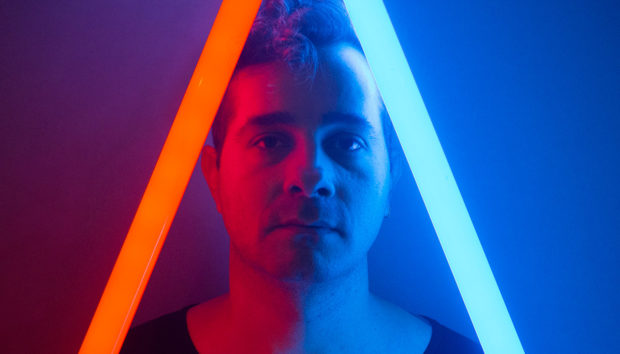
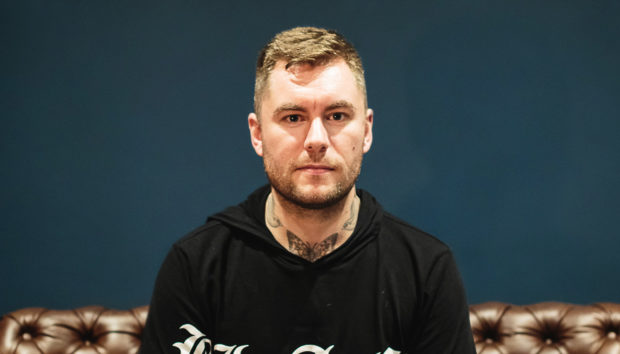

Few producers blur the line between musician and electronic artist like Father Funk. His new album, Funk The System, captures the chaos and color of live performance inside a bass-heavy electronic framework. Each track moves with real musicality, drawing from years of experience as a bassist, guitarist, and drummer.
It is loud, unapologetic, and unmistakably human.
For Father Funk, sound design and performance are inseparable.
He builds each track from the ground up as if he were sampling an old record, using tools that feel organic and responsive. Scarbee® Bass plays a key role in that process, letting him translate the nuance of a live instrument into the energy of a drop.
Funk The System marks a turning point for the UK-born, Vancouver-based producer. After a decade of genre-hopping collaborations and festival anthems, this project captures his creative independence in full form.
Jump to these sections:
- Building sampled foundations with live tone
- Programming realism through detailed MIDI phrasing
- Balancing low-end warmth and definition
- Using MIDI feel for movement and punch
- Adding character through articulation and tone
- Strengthening groove through MIDI programming and swing
The record balances raw funk attitude with heavy low-end power, guided by the precision and playability of Native Instruments’ Scarbee Jay-Bass – one of hundreds of premium Kontakt instruments.
When you sat down to write Funk The System, how often did the first idea come from the bass, and where did Kontakt instruments fit into those early sessions?
A lot of this record started with concepts rather than specific ideas. An obvious one would be Jazzercise – a fusion of Jazz and Dubstep. With a concept like this I would often start with the “live” elements such as guitars, keys, and drums. My music used to be mostly sample-based, so my goal with these early sessions is to build a foundation that sounds like it could have been sampled from an old record. Then I dissect that (whether by stemming it out or resampling) and use that to build the rest of the song.

Scarbee bass instruments in Kontakt are definitely some of my go to tools for these kinds of sessions. I love how warm and round they sound.
Generally, I’m mostly using Scarbee Jay-Bass as part of a drop. I’ll process it with multiple types of distortion followed by an OTT to make it super aggressive and in your face. That way I can use it as part of a phrase alongside the other basses in the drop and it doesn’t get lost in the mix.
Scarbee Jay-Bass responds in a very natural way. How do you shape phrasing inside the plugin so the part feels played rather than programmed?
This is how you get plugins like this to sound “real”. You can shape the sound so much just by playing with the MIDI notes – note length, velocity, etc. Being a bass player myself definitely helps with this, as I know how the instrument works and how a part would be played.

Ghost notes are super important. These are very short, often swung syncopated notes in between the more significant notes in a phrase. If you lower the velocity enough on Scarbee Jay-Bass you can make your ghost notes sound less like actual notes and more like muted percussive hits.

This is exactly how it would sound if you were playing a real bass. It also helps to make the note following a ghost note have full or near-full velocity.
Even just the length of individual notes can make a huge difference.
Obviously, if you’re playing a real bass each note isn’t going to be fully legato so it’s important to mess around with this. I love that if you extend one MIDI note into the next, it creates a hammer-on effect.
Pro tip from Father Funk: Let the MIDI do the work. Use ghost notes, velocity and varying note lengths to create interesting, realistic patterns.
A lot of the album carries a thick low end that still stays clear. How does Kontakt help you keep weight and definition in busy arrangements?
Scarbee Jay-Bass has a really nice low end. It’s a big part of the reason I love it so much. As I mentioned, I’m a bass player, so I could quite easily record a lot of the bass parts in my songs if I wanted. But I usually prefer to use the Kontakt Scarbee basses as they are easier to get a super solid consistent sound – especially in the low end.

Using compression and some often extreme EQ really helps with bringing out the frequencies I need more of, but I’d say that a lot of the processing I’m doing is more to bring out the high end than the low end, as that’s what gets lost when using Scarbee Jay-Bass in the more aggressive styles of music that I’m producing.

I will often layer Scarbee Jay-Bass with a separate sub, but it totally depends on what part it’s playing. If it’s more of a slap bass part, it definitely makes more sense to try and bring out the sub from the plugin as you wanna feel that pop. If it’s doing more of a simple fingered part, layering a separate sub underneath can work nicely.
When you want a bassline with extra movement or attitude, which controls inside Kontakt do you use first to push expression?
Honestly I don’t really touch the controls.
I get all the character of the sound from the MIDI programming (note length, velocity etc) and from post-processing. I’m usually just picking between the neck pickup and the bridge pickup, depending on what sound I’m going for.

If extra attitude is what I’m after, I’m definitely gonna try doing a slap bass part which will involve lots of notes at full velocity, lots of hammer-ons and lots of jumping between octaves. Then I’ll give that plenty of distortion to make it sound even more aggressive.
Pro tip from Father Funk: Add distortion to take the sound of the plugin to the next level.
Many lines on the record feel full of character. How do you dial in tone, grit, or accents inside Kontakt to bring that personality to the front?
As I mentioned, I think a lot of this comes from the MIDI programming, which is very much informed by my experience playing bass across multiple genres.
Kontakt instruments respond really well to slight changes in velocity and note length so it’s really easy to add some personality to a phrase – even to single notes.
Even the exact same MIDI pattern can trigger slightly differently each time, so I’ll often resample phrases multiple times until I get the articulations I’m looking for. This might also involve comping a few different “takes” together.
For producers who want more musical shape in their low-end writing, what would you point them toward to strengthen groove and articulation?
I sound like a broken record here, but so much of it comes from the MIDI programming. I think it’s worth spending some time experimenting with that to get the most out of the instrument. It might sound time-consuming but once you have an understanding of what works and how the plugin responds, it’s super quick and easy to get something that sounds realistic.
Swing really helps with making things groovy and lively. Especially in funk music, you’d struggle to find a bass player who doesn’t play with swing and groove. My go to is the Notator 16D Swing in Ableton.
Pro tip from Father Funk: Resample! This way you can be sure your patterns are triggering the way you want. You might also want to clean up some of the tails on the sounds to tighten things up.

Wrapping it all up
Funk The System is more than a statement of style.
It is a reminder that digital music can still feel alive when it springs from a performer’s instincts. For Father Funk, basses in Kontakt bridge that gap, connecting the discipline of musicianship with the flexibility of production. Every detail, from ghost notes to hammered slides, speaks to the idea that movement and emotion come from touch as much as tone.
This balance defines his artistic evolution. By merging MIDI control with the imperfections of live phrasing, he finds new ways to make electronic music feel personal again. Kontakt is part of that identity, a tool that gives his low end not only power but character.
In a scene often built on pre-made loops and polished presets, Father Funk proves that groove still comes from intent. Funk The System stands as a record made by someone who never stopped thinking like a player. The result is loud, fearless, and full of life.
Related articles
-
Behind the synth: A. G. Cook on stacked sawtooths and the creation of Super*Saw
Explore the extremes of stacked sawtooth waves with Super*Saw, a new synthesizer co-created with A. G. Cook. Learn how to…
-

Inside the evolution of orchestral sampling: an interview with ProjectSAM
Discover how ProjectSAM’s Lineage Series uses NKS and smart features to change orchestral sampling. Plus, save on instruments in our…
-
How New Constellations turn emotion into sound with Massive X
Go inside the studio with New Constellations. Learn how they use Native Instruments gear, happy accidents, and lifelong friendship to…
-
Citizen Kain on building emotion and space with Replika
Citizen Kain explains how Replika helped shape the rhythm, tension, and emotion behind his debut Eversun Records single “Moments.”…
-

The organic precision behind Calcou’s Anjuna release featuring Reaktor
Calcou shares how Reaktor, Monark, and Super 8 shaped the creative balance and live energy behind their new duo EP,…
-
14 NKS instruments that will change the way you create music
Discover 14 NKS instruments to freshen up your workflow. From lo-fi tape synths to cinematic strings, shop the Native Instruments…
-
Parallelle on crafting living basslines with Reaktor and TRK-01
Parallelle share how Reaktor and TRK-01 shape the bass and warmth in 11th Avenue, balancing analog depth with modern control.
-
Where will your sound lead you? Explore the Native Instruments Summer Sale
Save 30% on instruments, effects, and sounds in our Summer Sale. Find the tools to keep your tracks moving and…