


St. Mary’s debut EP Amen arrives on bitbird as a bold creative statement, bridging spirituality and chaos through sound design, emotion, and storytelling. Written as a musical confession, Amen explores personal transformation through both turbulence and calm, tracing a path from disorder toward acceptance. The project serves as a clear introduction to her artistic voice, using sonic detail to mirror inner change.
Central to the record’s world are the instruments that built its emotional center.
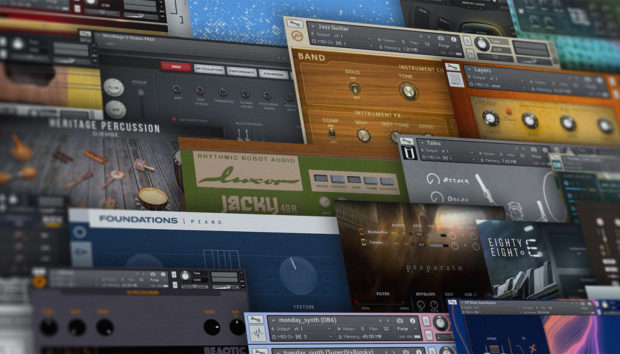
Kontakt choirs, organs, and strings appear throughout the EP, serving as anchors for reflection, while Guitar Rig adds tension, distortion, and release. Together, they shape an environment that moves between aggression and introspection, blending human expression with digital experimentation.
Throughout Amen, St. Mary uses her technical precision to serve storytelling. Each track connects to a single emotional thread: conflict, surrender, and renewal, tied together through the same instrumental palette.
Jump to these sections:
- Building a confessional EP through instinct
- Creating chaos in “Psych Ward!”
- Testing Kontakt sounds within dense mixes
- Managing space and vocal clarity
- Shaping structure and emotional unity
- Recontextualizing choirs and organs
The result is a record that feels cinematic yet deeply personal, capturing the intersection of her inherent intensity and the release of all tension in her evolving creative identity. Now let’s get into the full interview.
When you began shaping the emotional arc of the EP, how early did instrument choice in Kontakt influence the decision to divide the project into two distinct halves?
The EP naturally took shape as I followed the flow of what I was feeling and creating. When I was drawn to more introspective songs, I leaned on Kontakt instruments like choirs, organs, and strings to create a reflective, prayer-like space.

When I wanted to explore a more aggressive edge, I experimented with sounds through unconventional processing, adding grit, movement, and intensity that transformed the original instruments.

Over time, this approach created a clear emotional divide; two halves that contrast with each other but still feel like part of the same universe.
For the high-intensity sections of “Psych Ward!”, what led you toward sharper, percussive Kontakt patches, and how did those choices support the feeling of internal pressure that drives the track?
For the high-intensity sections of “Psych Ward!”, I was intentionally drawn to sharper, more percussive Kontakt patches because they mirror the feeling of internal pressure and mental overload the track is built around.
I wanted sounds that felt almost intrusive; therefore, elements that cut abruptly and repeat obsessively, heightening the tension throughout the track.

I ran many of these patches through Guitar Rig, using it more as a distortion and character processor than a traditional amp simulator. This allowed me to quickly transform organic sounds into edgy, unstable soundscapes and effects, reinforcing the persistent sense of pressure and unease that drives the song.
Pro tip from St. Mary: Take the time to shape a single sound into exactly what you envision, rather than stacking multiple layers to compensate. Over-layering often leads to unnecessarily dense productions and makes mixing harder to navigate. A few well-made sounds will always translate better.
How do you evaluate Kontakt instruments for their ability to cut through dense production during the chaotic parts of the EP?
I evaluate them less by how “big” they sound on their own and more by how clearly they occupy a specific role in the frequency and emotional spectrum once everything is layered. During the more chaotic sections of the EP, I’m looking for Kontakt instruments that have a strong midrange identity or a distinct transient character that can survive heavy drums, bass, and distortion without needing excessive processing.

I’ll often test them early by dropping them straight into the densest part of the arrangement and seeing how much work it takes for them to speak. If something needs constant EQ carving or extreme volume automation, it’s usually not the right choice.
I also pay close attention to how an instrument responds to post-processing and dynamics. Instruments that retain clarity when pushed through saturation, filtering, or aggressive automation tend to cut through best. Ultimately, the goal isn’t for the Kontakt layer to compete with everything else, but to feel intentional within the chaos without cluttering the mix.
Pro tip from St. Mary: When starting a track, try to push it to a strong demo stage within that first session. Your mindset and emotional clarity won’t be the same later, so it’s important to capture the core intention, whether that’s songwriting, sound design, or overall direction, while you’re in that zone. Most of the big answers live there, and revisiting an unfinished idea later can make it much harder to stay true to what you originally wanted to say.
When working on the calmer tracks, what techniques helped you maintain space while still giving the Kontakt layers enough presence to feel meaningful?
One technique I relied on heavily was sidechaining the lead vocal to the Kontakt instruments, particularly the strings and organs.
This creates space for the vocals to cut through the mix, while allowing the Kontakt layers to return to full presence when the vocals drop out naturally. It keeps the arrangement feeling dynamic rather than static. To take this a step further, I often sidechain only the vocal frequency range instead of the entire signal, so the instruments aren’t being fully ducked, just the frequencies that would clash with the voice.

This results in much more natural-sounding volume and EQ movement. I also use subtle panning on smaller string lines and embellishments, which prevents overcrowding in the center and gives those elements a moment to shine without overwhelming the mix.
Pro tip from St. Mary: Some of the best and worst advice will come from those closest to you. Everyone speaks from their own experience, and what worked for someone else may not work for you. No one understands your vision better than you do, so while it’s important to listen and stay open, always run feedback through your own instincts before acting on it.
How do you balance contrasting sound palettes across a project while keeping the overall identity unified?
One of the biggest anchors for this project was the overall storytelling arc. If you listen closely, every song on the EP carries religious undertones and is written in the first person, almost like a prayer. From the opening line “Take me to a higher place,” to “Take me to the psych ward,” to “Take Me Away,” it’s not meant to be immediately obvious, but all of these phrases express the same internal desire. To escape, to be relieved, to be somewhere else. That emotional throughline helped unify the project even as the sound palettes shifted.

On a more technical level, I also intentionally kept certain musical elements consistent.
For example, the first two tracks are in the same key (D minor), are only five BPM apart, feature female old-school rave-influenced vocals, and share the same structure: intro, verse, buildup, drop, buildup, drop, outro. In the second half of the EP, both tracks feature male vocals and are designed to transition directly into each other when listened to in sequence.
By keeping these structural, tonal, and conceptual elements aligned, I was able to let the sound palettes contrast while still grounding the EP as one cohesive body of work.
Pro tip from St. Mary: You’ll become a better producer much faster by completing more songs, even if they’re not ‘perfect’, than by endlessly polishing a handful of tracks. Finishing teaches you far more than tweaking, and the faster you complete music, the more you’ll ultimately create over your lifetime (which is the whole point!)
Did any Kontakt instruments end up appearing in both halves of the EP, and if so, how did you adapt them to serve different emotional functions?
Yes, both the Jacob Collier Audience Choir and the Vintage Organs Kontakt instruments appear throughout the entire EP. Even though the project is split into two distinct halves, one more aggressive and one more introspective, it was important to me that both sides still felt like they existed within the same universe.

On the more songwriting-driven, introspective half, the choir plays a supportive role, subtly enhancing the lead vocals and emotional weight of the songs. On the more aggressive, sample-based half, the choir moves to the foreground and becomes a defining element, helping set the overall tone of the EP as something epic, cinematic, and larger than life.
Pro tip from St. Mary: One of the easiest ways to develop a unique sound is to pull elements from entirely different genres. That’s how music evolves, and we’ve seen this a lot with the crossover of hyperpop and EDM in recent years. There are no real rules. Some of the most interesting ideas come from not taking things too seriously and allowing yourself to experiment, be vulnerable, and try things that might initially sound “wrong.”
Wrapping it all up
With Amen, St. Mary introduces herself as an artist capable of translating emotion into sound with both precision and vulnerability. Kontakt and Guitar Rig provided the foundation for that transformation, allowing her to bridge chaos and calm while preserving the honesty of each moment.
The record’s structure reflects both ritual and release, inviting listeners to experience conflict and healing in real time. As her first complete body of work, Amen establishes St. Mary’s voice as one rooted in authenticity, spirituality, and exploration through sound.
Related articles
-
Behind the synth: A. G. Cook on stacked sawtooths and the creation of Super*Saw
Explore the extremes of stacked sawtooth waves with Super*Saw, a new synthesizer co-created with A. G. Cook. Learn how to…
-

Inside the evolution of orchestral sampling: an interview with ProjectSAM
Discover how ProjectSAM’s Lineage Series uses NKS and smart features to change orchestral sampling. Plus, save on instruments in our…
-

How New Constellations turn emotion into sound with Massive X
Go inside the studio with New Constellations. Learn how they use Native Instruments gear, happy accidents, and lifelong friendship to…
-
Citizen Kain on building emotion and space with Replika
Citizen Kain explains how Replika helped shape the rhythm, tension, and emotion behind his debut Eversun Records single “Moments.”…
-

The organic precision behind Calcou’s Anjuna release featuring Reaktor
Calcou shares how Reaktor, Monark, and Super 8 shaped the creative balance and live energy behind their new duo EP,…
-
14 NKS instruments that will change the way you create music
Discover 14 NKS instruments to freshen up your workflow. From lo-fi tape synths to cinematic strings, shop the Native Instruments…
-
Parallelle on crafting living basslines with Reaktor and TRK-01
Parallelle share how Reaktor and TRK-01 shape the bass and warmth in 11th Avenue, balancing analog depth with modern control.
-
Where will your sound lead you? Explore the Native Instruments Summer Sale
Save 30% on instruments, effects, and sounds in our Summer Sale. Find the tools to keep your tracks moving and…