
For French brothers Thomas and Julien, better known as Parallelle, the creative process has always been guided by feel rather than formula. Their new album, 11th Avenue, captures that philosophy perfectly, blending jazz, house, and analog soul with the precision of modern production tools. The project’s standout moments came from tools that encouraged movement, imperfection, and flow. This is particularly true with TRK-01 and Reaktor.
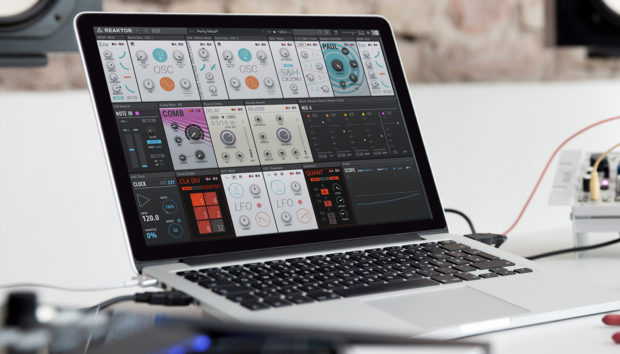
When producing tracks like “Radio 101” and “Take You On A Ride,” the duo leaned heavily on Reaktor’s modular depth and tactile tone to help them find new ways to merge their hybrid world of digital sound design and acoustic warmth. TRK-01 also helped them shape basslines that feel alive rather than sequenced.
Jump to these sections:
- Capturing real moments in “Radio 101”
- Rebuilding presets for punch and flow
- Keeping warmth inside digital systems
- Blending analog depth with digital tone
- Treating sound design as performance
- Expanding creative freedom through Reaktor
The result is a body of work that feels spontaneous but deeply intentional, carrying the pulse of a live band within the clarity of electronic precision; so let’s see how they do it.
How did the bassline for “11th Avenue” first come together, and at what point did you decide TRK-01 would be the anchor?
The bassline for “Radio 101” (on the 11th Avenue LP) actually came from a very real moment: returning home after a long Ibiza weekend, especially a Monday spent at Circoloco. That rolling, hypnotic tech-house bass that keeps a room moving for hours was still looping in our heads. We knew we wanted something that captured that raw late-night energy, a pattern that feels simple at first but opens into movement and tension the longer you listen.
TRK-01 became the anchor pretty quickly.
We’re drawn to its particular mix of analog-style weight and modern modulation, which is hard to find in one tool. It gives you that gritty, tactile low-end, but it also lets the sound travel with evolving movement. For us, the bassline has to feel alive, almost like another band member, and TRK-01 allows exactly that. It gave us the elasticity and attitude we needed to make the track feel both club-ready and unmistakably Parallelle.
Did you begin with a preset inside TRK-01 or build your patch completely from scratch?
We actually started from the Slappy preset because it already carries a sense of a performed bass, almost like a session player with a slightly unpredictable touch. That was the right starting point for the vibe we wanted: organic, expressive, and not too square. But from there, we rebuilt the patch quite extensively.
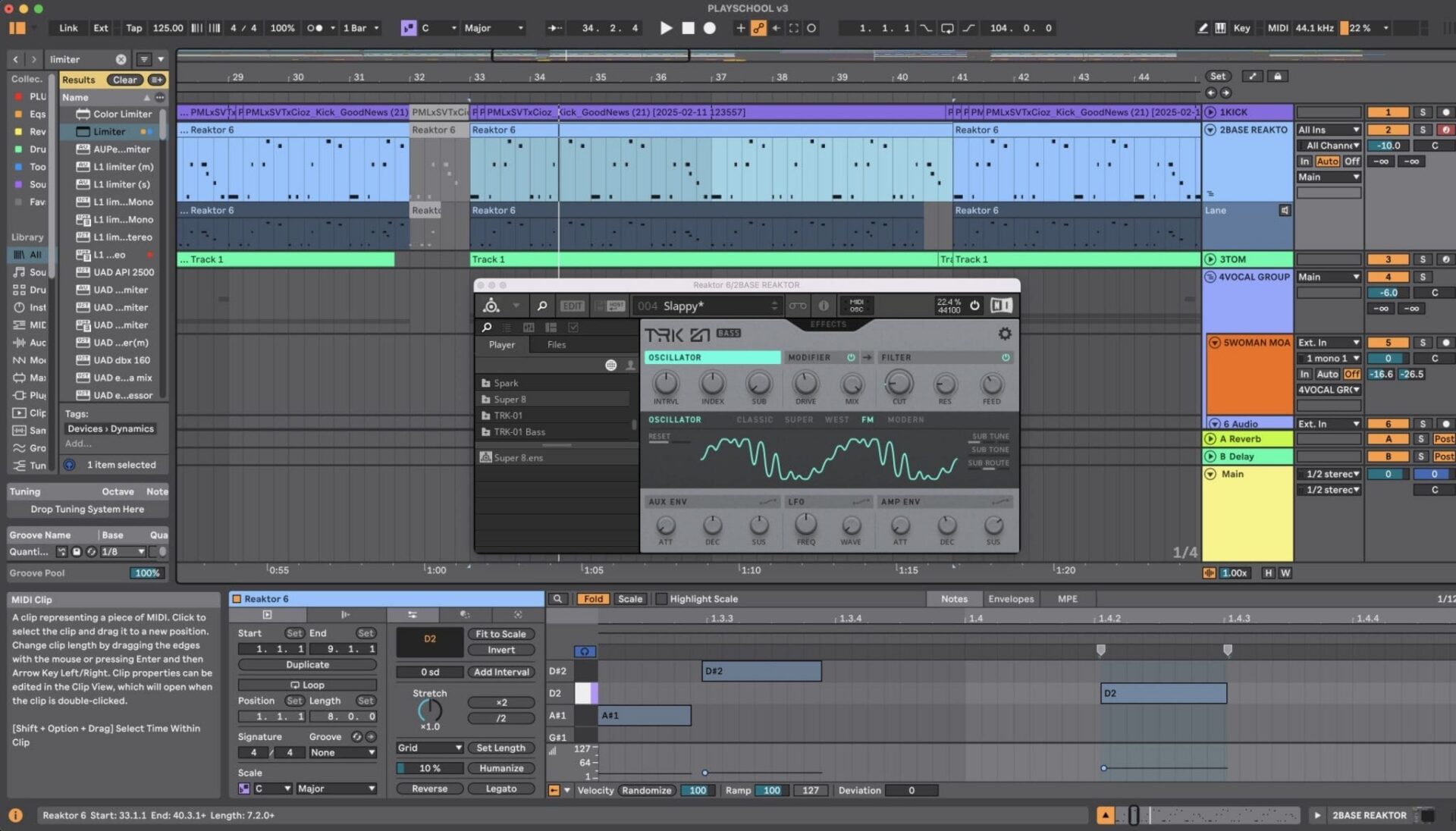
We switched the engine to FM mode because it reacts more dynamically in a club mix. To sharpen the transient, we set the attack to 0, giving the bass that instant punch at the top of every note. Decay around 350 ms keeps the sound tight and rhythmic, and we narrowed the sustain to preserve that slap-like snap. The result is a bass that feels human and funky, but still cuts through a sound system with the firmness you expect from dance music.
Your tracks always carry warmth and physicality, even when built digitally. How do you maintain that tactile quality when working with Reaktor?
For us, warmth begins with how you play, not just what you use. Even when triggering digital instruments, we always play parts on weighted MIDI keys, so the velocity and touch vary naturally. Nothing is perfectly quantized, we keep slight imperfections in timing to preserve that breathing, organic feel. Those details add human tension to an otherwise digital environment.

Inside Reaktor, we gravitate toward instruments that already carry analog DNA. TRK-01 Bass is one pillar, but Monark is equally important in our palette. Its envelopes and filters behave like a classic Moog, with that roundness and saturation that instantly gives weight to a track. We often blend Reaktor synths with acoustic textures so that the digital elements inherit some of that warmth through contrast.
This combination lets us keep the physicality of real instruments even in a fully digital mix.
How do live instruments and analog gear interact with your digital layers when you mix everything down?
We love to create a hybrid ecosystem where digital and analog naturally feed into each other. Live instruments such as Rhodes, trumpet, and saxophone bring a familiar warmth, they ground the listener in something human. When these acoustic layers sit next to our synths and digital textures, they pull everything into a more emotional space.

On the analog side, instruments like the Juno, Prophet Rev2, Moog Sub37, and various drum machines give us depth and unpredictability, slight tuning movement, filter drift, noise floors. When blended with Kontakt, Reaktor, and other NI plugins, the mix becomes wider and richer. The contrast between clean digital precision and analog imperfections helps the final track feel vibrant, physical, and multi-dimensional.

You often blur the line between performance and production. Does that philosophy extend into your approach to sound design?
Absolutely.
When we perform, we’re constantly improvising, pushing sounds, extending ideas, and reacting to each other. That spontaneity often reveals textures or structures we wouldn’t discover if we only worked inside a DAW. So the performance mindset flows directly into sound design: we’re always looking for that moment of discovery where something imperfect becomes beautiful.
We think of sound design as building a living organism. A patch shouldn’t feel static; it should grow, breathe, surprise, and evolve as the track progresses. That philosophy is very present on ‘11th Avenue’, which draws heavily from the freedom of 1980s jazz lounges, where music was allowed to stretch and morph. That same attitude guides our digital sound design today: everything should feel alive, expressive, and a little unpredictable.
After experimenting with TRK-01 on “11th Avenue,” do you see Reaktor becoming even more central to your creative process in future projects?
TRK-01 has essentially become our primary bass tool. It hits the sweet spot between analog-style tone shaping and precise modern control. The way you can layer modulation, distortions, envelopes, and sequencing gives us a bassline that feels cinematic and fluid, not just functional. It has the punch for clubs but also the detail for headphones, which is rare.

Reaktor as a whole is becoming a bigger part of our workflow because it allows us to break out of predictable templates. Its modular nature encourages experimentation and that’s where our best ideas usually start. So yes, you’ll definitely hear more TRK-01 and more Reaktor-based textures in our future releases.
Wrapping it all up
Parallelle’s workflow is built around intention and touch. TRK-01 has become central to their low-end design, giving them a foundation that feels physical while remaining flexible for modern production. Reaktor supports that balance by offering modular freedom without losing musicality.
Their live shows follow the same principle. They bring real instruments such as trumpet, Rhodes, and saxophone into sets that also feature Reaktor’s bass engines and Monark’s warmth. The result feels cohesive and alive, bridging acoustic energy with electronic control. Each sound carries personality, shaped through both instinct and experience.
Moving forward, the duo plan to keep expanding this hybrid space. They approach every project as an opportunity to explore new combinations and rediscover the value of simplicity. Their goal remains clear: music that feels human, moves with purpose, and connects through sound alone.
Related articles
-
Behind the synth: A. G. Cook on stacked sawtooths and the creation of Super*Saw
Explore the extremes of stacked sawtooth waves with Super*Saw, a new synthesizer co-created with A. G. Cook. Learn how to…
-

Inside the evolution of orchestral sampling: an interview with ProjectSAM
Discover how ProjectSAM’s Lineage Series uses NKS and smart features to change orchestral sampling. Plus, save on instruments in our…
-
How New Constellations turn emotion into sound with Massive X
Go inside the studio with New Constellations. Learn how they use Native Instruments gear, happy accidents, and lifelong friendship to…
-
Citizen Kain on building emotion and space with Replika
Citizen Kain explains how Replika helped shape the rhythm, tension, and emotion behind his debut Eversun Records single “Moments.”…
-

The organic precision behind Calcou’s Anjuna release featuring Reaktor
Calcou shares how Reaktor, Monark, and Super 8 shaped the creative balance and live energy behind their new duo EP,…
-
14 NKS instruments that will change the way you create music
Discover 14 NKS instruments to freshen up your workflow. From lo-fi tape synths to cinematic strings, shop the Native Instruments…
-
Where will your sound lead you? Explore the Native Instruments Summer Sale
Save 30% on instruments, effects, and sounds in our Summer Sale. Find the tools to keep your tracks moving and…
-

How Mr. Bill builds sonic worlds in Massive X
Mr. Bill explains how Massive X and instinctive sound design shaped the storytelling process behind his new downtempo album, Mr.