
For Calcou, collaboration marks the start of a new era.
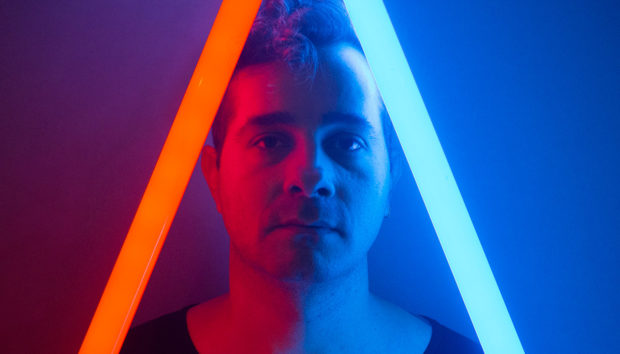
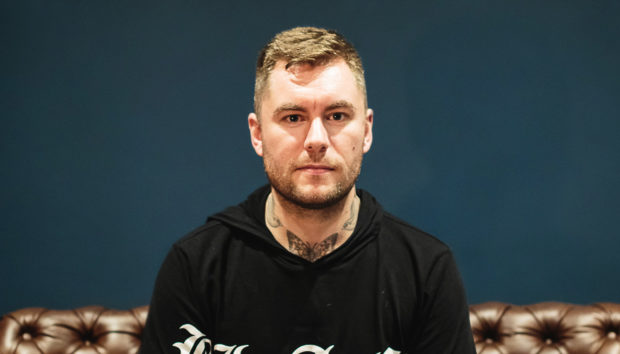
With Now, What?, the Berlin-based producer expands his solo project into a full-fledged duo, joined by vocalist and songwriter Thea. The record captures the moment when two creative perspectives meet, balancing live performance, electronic production, and songwriting with clarity and purpose.
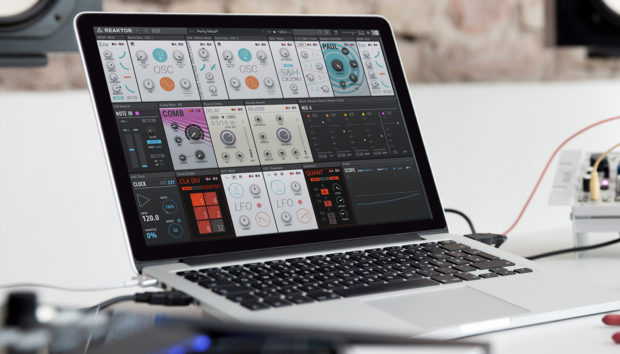
The EP feels equal parts experimental and direct, pairing organic textures with modular energy. Tracks like “Closer” and “Green Hills” reveal how their shared workflow builds tension between natural warmth and precise rhythm. That balance begins with tools like Native Instruments’ Reaktor, Monark, and Super 8, which give them both structure and freedom.
What makes Now, What? so compelling is how it connects emotion to workflow. Reaktor and Monark help them find honest results fast, avoiding the distractions of overproduced polish. Jump to these sections:
- Discovering creative chemistry as a duo
- Using Reaktor as a direct toolkit
- Exploring Reaktor ensembles for inspiration
- Building live setups around clarity and control
- Performing with intention and visible energy
- Keeping collaboration human and process-driven
It’s a record born from curiosity, where every sound starts as an experiment and ends as something distinctly human. Follow along with your own copy of Reaktor and get free Reaktor presets that Calcou uses in their music.
How did you first realize your individual production styles could actually complement each other instead of clashing?
Thea: We’ve already been making music side by side for quite a while before officially working as a duo, so we naturally discovered each other’s strengths early on. Stefan usually takes over the role as composer and producer while I step in as the singer and songwriter.
Stefan: If Thea works on production, she does it in her own DAW and sends me stems. So our styles don’t really clash, it’s more of a give-and-take where we share feedback and fine-tune each other’s input until we’ve found a vibe we both like.

What makes Reaktor such an essential part of your creative workflow as a duo?
Stefan: Reaktor is refreshingly no-bullshit. In the early demo phase, a lot of VSTs trick you with huge reverbs, delays, and glossy atmospheres that make your sketch feel more finished than it really is.

Then later, when you actually produce the track and start stripping things down, you suddenly realize the sound had no real core. Reaktor is the opposite. Its presets are effect-light and built on solid, pushable foundations.
They give us clarity in the arrangement — you instantly know whether an idea actually works when you’re not hiding behind a wall of effects.
Pro tip from Calcou: Before you dig into sound design, load a simple, clean Super 8 patch. Start with 2 note harmonies, 3 note maximum. Make sure you can tell a story with as few notes as possible. Focus on chord progression and voice leading until you have a loop that triggers something in you. If you’re able to achieve that with a simple saw-tooth patch, you have a good composition and an even better starting point for sound design.
Are there specific Reaktor ensembles you keep coming back to for generating unexpected ideas?
Together: Absolutely – Reaktor Blocks is our wild card. It always surprises us, maybe partly because we don’t fully understand all the modular routing, but that’s part of the charm.
We’ll start from presets, tweak until something breaks beautifully, and then follow that thread.
- Blips is amazing for quirky rhythmic elements.
- Drive and Monark Mikro give us the gritty, upfront dirt we often use to glue ideas together.

Pro tip from Calcou: If you found a preset you like, stick with it. Use it across your songs, but also use it inside the same song. If you e.g. found a great pad sound, why not pitch it down, make it mono and use it as the starting point for your bass? Or why not pitch it up, make it mono and use it as the starting point for the lead? Sometimes this can be really helpful to keep your overall vision and use sounds that match instantly.
For your live setups, do you pre-program Reaktor patches for each show, or do you leave room for improvisation?
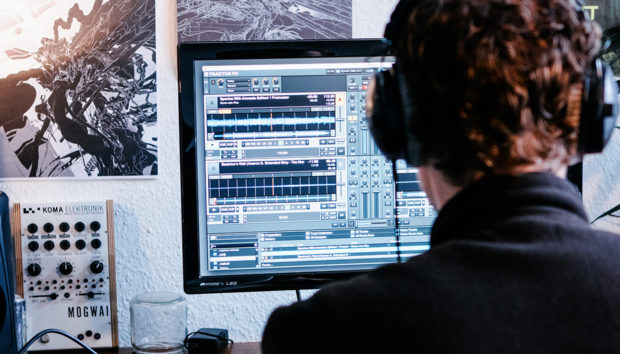
Stefan: We run a mix of Reaktor presets and an Ableton performance pack, which triggers the corresponding Reaktor patches and effect chains in our VST channel.
Thea: Our studio arrangements usually have more than 100 tracks per song so we needed to find a way to translate that to a stable live-set. Improvisation happens more in between songs and also with effects and modulation.
Pro tip from Calcou: Your vision is strongest in the beginning; you don’t want to lose that to tweaking a kick-drum for 2 hours. Have your tools ready when you start, work as fast as you can. Presets are a great starting point, you can always fine-tune later.
How much of your performance relies on real-time manipulation versus pre-sequenced elements?
Thea: On stage we follow one rule that keeps us grounded: if the audience can’t feel it, we don’t fake it. There’s no magic in twisting 30 knobs to recreate tiny studio automations that no one in the room can actually hear. We want every gesture to matter – every move should translate directly into energy the crowd can grab onto.

Stefan: So yes, we do real-time manipulation – but only when the impact is clear, audible and a raw, real-time push is needed. Otherwise, we’ll simply bounce the element as audio to avoid MIDI chaos and keep the show solid.
Pro tip from Calcou: Reverse-engineer presets. If you found a preset you like, why not dig deeper into what the sound designers did there and try to recreate it yourself? It’s a great way to understand plugins and hardware synths better, especially if you just started out with a new piece of gear.
For younger producers working in pairs, what advice would you give on finding balance, maintaining chemistry, and finishing music that still feels alive?
Thea: The biggest thing is learning to protect the chemistry that made you want to create together in the first place.
You each bring different strengths, so instead of competing, agree early on who naturally gravitates toward what – sound design, arrangement, toplines, mixing – while still leaving space to switch roles when the track needs a fresh energy boost.
Stefan: To keep the music feeling alive, avoid getting stuck in endless perfection. Set milestones – “sound palette today,” “arrangement by Friday,” “mix decisions only after stems” – and stick to them.
Build in moments where you step away and return with fresh ears. And don’t be afraid to keep the human fingerprints – the imperfect take, the odd sound, the raw moment that made you both smile. That’s usually the soul of the track.
Pro tip from Calcou: If you don’t know where to start, start with a drone. Load a simple patch and just play one note. Make sure to choose a preset that has some movement in it so it’s soothing listening to, even if it’s just one note. Or add a ton of reverb and some slight modulations. Then start singing or playing whatever fits to that sound. It helps to limit the amount of endless choices and is an easy way to get rid of that awkward feeling of starting “naked.”
Wrapping it all up
Now, What? reflects a process built on trust, exploration, and shared instinct. Each track feels connected by the focus on movement and clarity. Reaktor, Monark, and Super 8 provide the framework that keeps their ideas grounded, while leaving enough space for natural flow and small imperfections that make the music feel alive.
Stefan and Thea approach collaboration with intention. They define roles early, exchange ideas quickly, and keep the workflow light. This discipline allows their creativity to stay open without drifting into hesitation or overthinking.
Their working method gives the EP its shape. Every choice serves the same purpose – to build songs that translate on stage and still hold emotion in the studio. Now, What? represents a forward step for Calcou, showing how precision and instinct can coexist within the same sound.
Related articles
-
Behind the synth: A. G. Cook on stacked sawtooths and the creation of Super*Saw
Explore the extremes of stacked sawtooth waves with Super*Saw, a new synthesizer co-created with A. G. Cook. Learn how to…
-

Inside the evolution of orchestral sampling: an interview with ProjectSAM
Discover how ProjectSAM’s Lineage Series uses NKS and smart features to change orchestral sampling. Plus, save on instruments in our…
-

How New Constellations turn emotion into sound with Massive X
Go inside the studio with New Constellations. Learn how they use Native Instruments gear, happy accidents, and lifelong friendship to…
-
Citizen Kain on building emotion and space with Replika
Citizen Kain explains how Replika helped shape the rhythm, tension, and emotion behind his debut Eversun Records single “Moments.”…
-
14 NKS instruments that will change the way you create music
Discover 14 NKS instruments to freshen up your workflow. From lo-fi tape synths to cinematic strings, shop the Native Instruments…
-
Parallelle on crafting living basslines with Reaktor and TRK-01
Parallelle share how Reaktor and TRK-01 shape the bass and warmth in 11th Avenue, balancing analog depth with modern control.
-
Where will your sound lead you? Explore the Native Instruments Summer Sale
Save 30% on instruments, effects, and sounds in our Summer Sale. Find the tools to keep your tracks moving and…
-
How Mr. Bill builds sonic worlds in Massive X
Mr. Bill explains how Massive X and instinctive sound design shaped the storytelling process behind his new downtempo album, Mr.