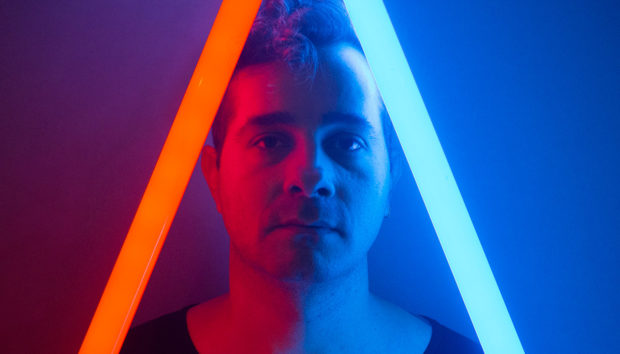
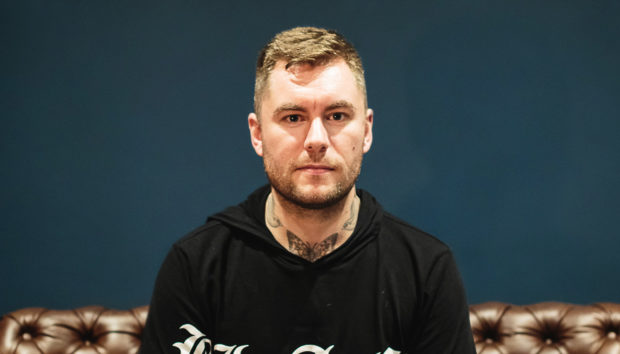



Felix Raphael’s new album DO YOU is a reflection of emotional range – pulling between doubt, healing, and fulfillment in a way that feels personal without losing momentum. Across the tracklist, there’s a deliberate push to keep every sound intentional. Whether it’s a short vocal phrase or a long pad section, everything sits inside a carefully built environment that can shift between grounded clarity and full-blown spatial lift.
That sense of balance carries over into his live set, where Raum plays a direct role in shaping the dynamic of the performance. Instead of static reverb settings baked into the session, Felix approaches Raum like a live instrument, mapped to return channels and modulated in real time. It gives him the freedom to hold a phrase, set the tone of a transition, or even reshape the stereo field in front of an audience.
Jump to these sections:
- Mapping Raum across return channels
- Balancing emotion and control in live performance
- Using Raum to mirror emotional shifts
- Shaping vocal space in Creation
- The discipline of restraint and the art of negative space.
- Integrating hardware and software on stage
The result is a rig that blends studio depth with stage presence, relying on control, subtlety, and attention to space. Here’s how Felix breaks down his approach to Raum, from studio sessions to full-stage sets.
How do you map Raum’s size, decay, and mix for smooth live transitions?
The magic is in the send channels.
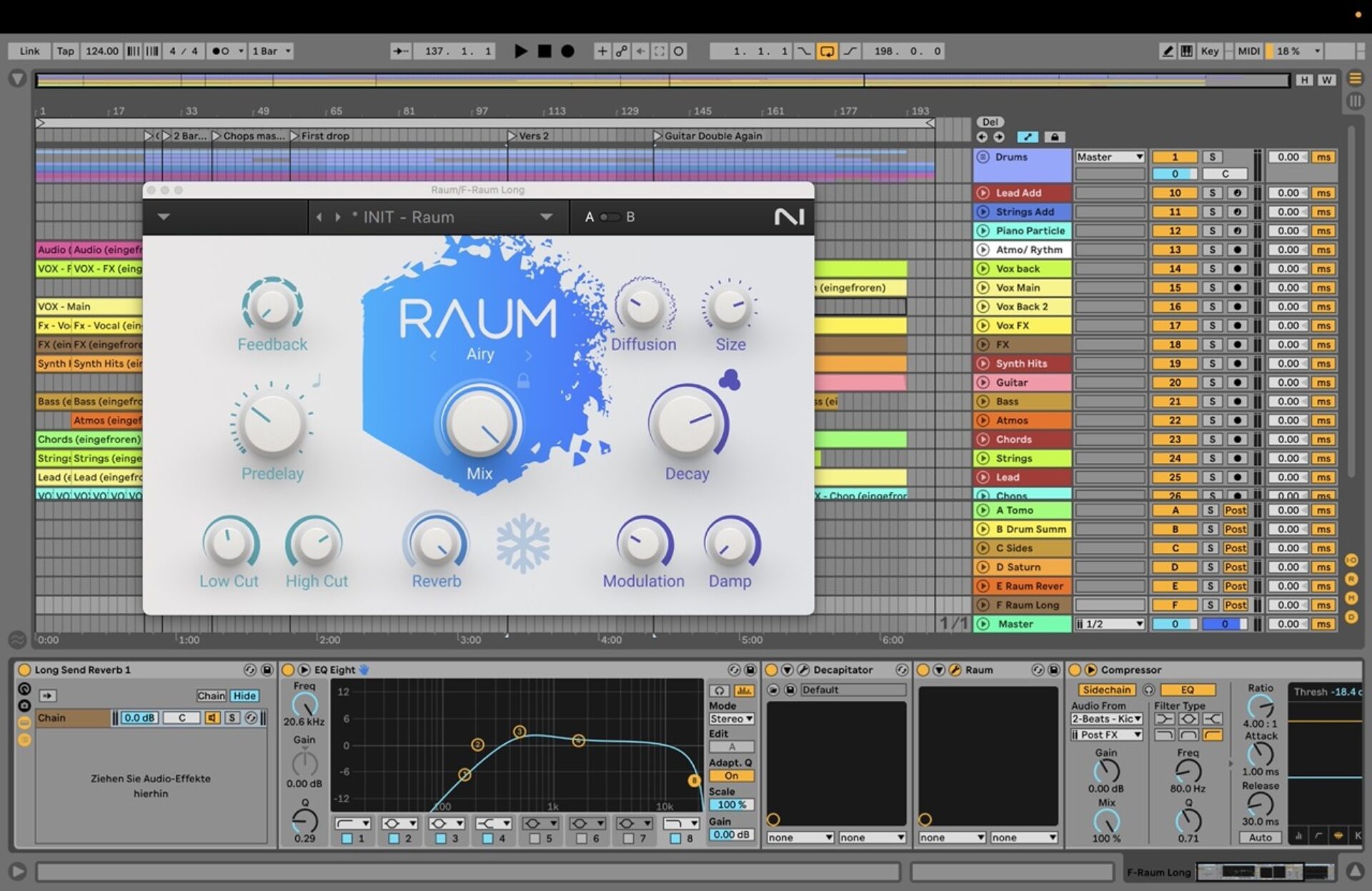
I treat Raum like an instrument with two dedicated return buses: a “Room” return for intimate presence and a “Atmos/Drones” return for expansive swells.
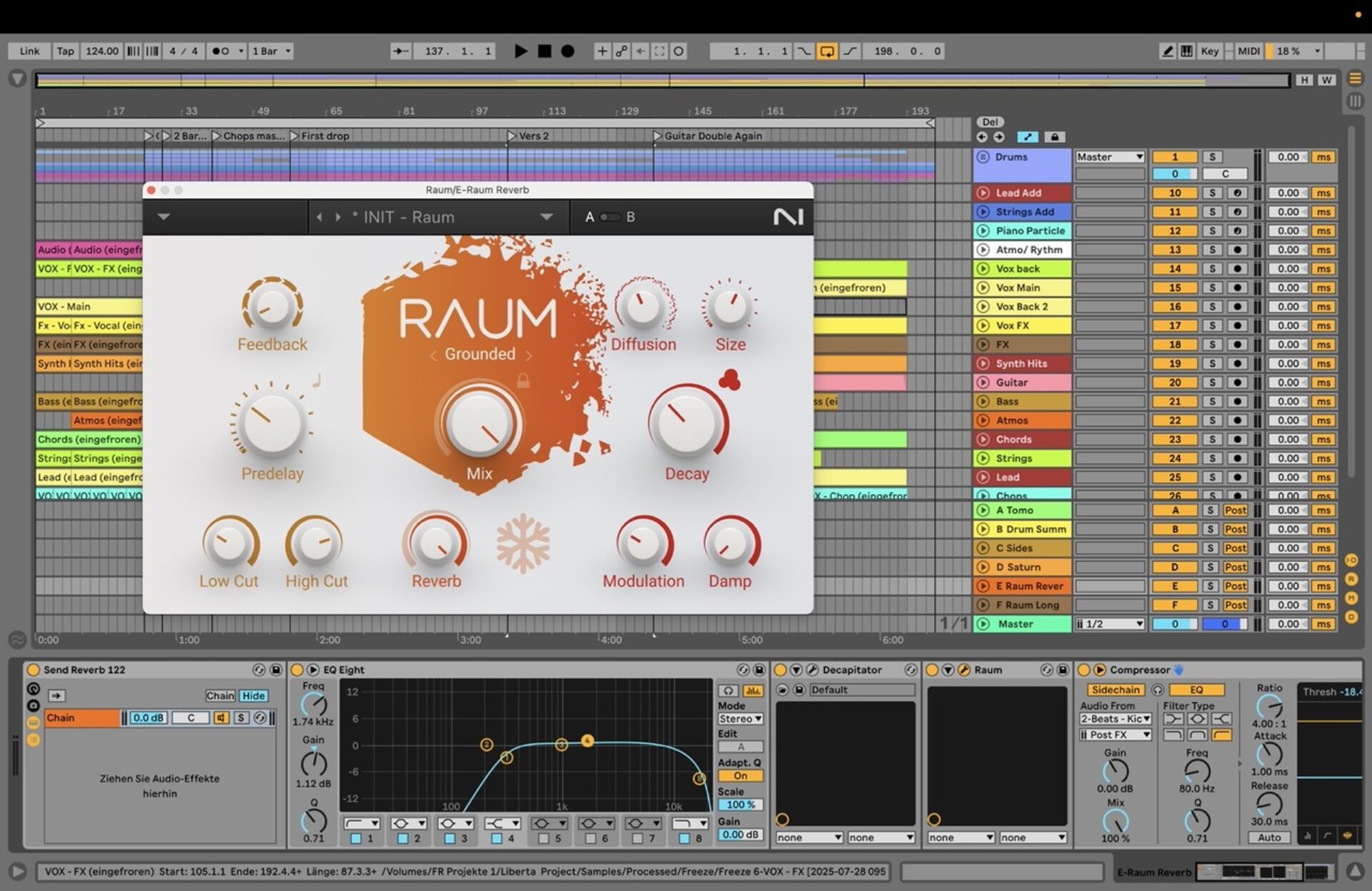
On the room bus, I map the mix knob to a long-throw fader with a conservative range (roughly 10–35%). I keep decay short so I can lift the vocal or guitar slightly without washing it out.
On the Atmos/Drones bus, a single macro nudges size and decay together in gentle arcs, while pre-delay stays in the 20–60 ms pocket to preserve articulation. Working with return sends instead of inserts lets me ride depth independently from the dry source. That allows transitions to feel like staging – moving performers closer or further on an imaginary stage – rather than flipping an effect on and off.
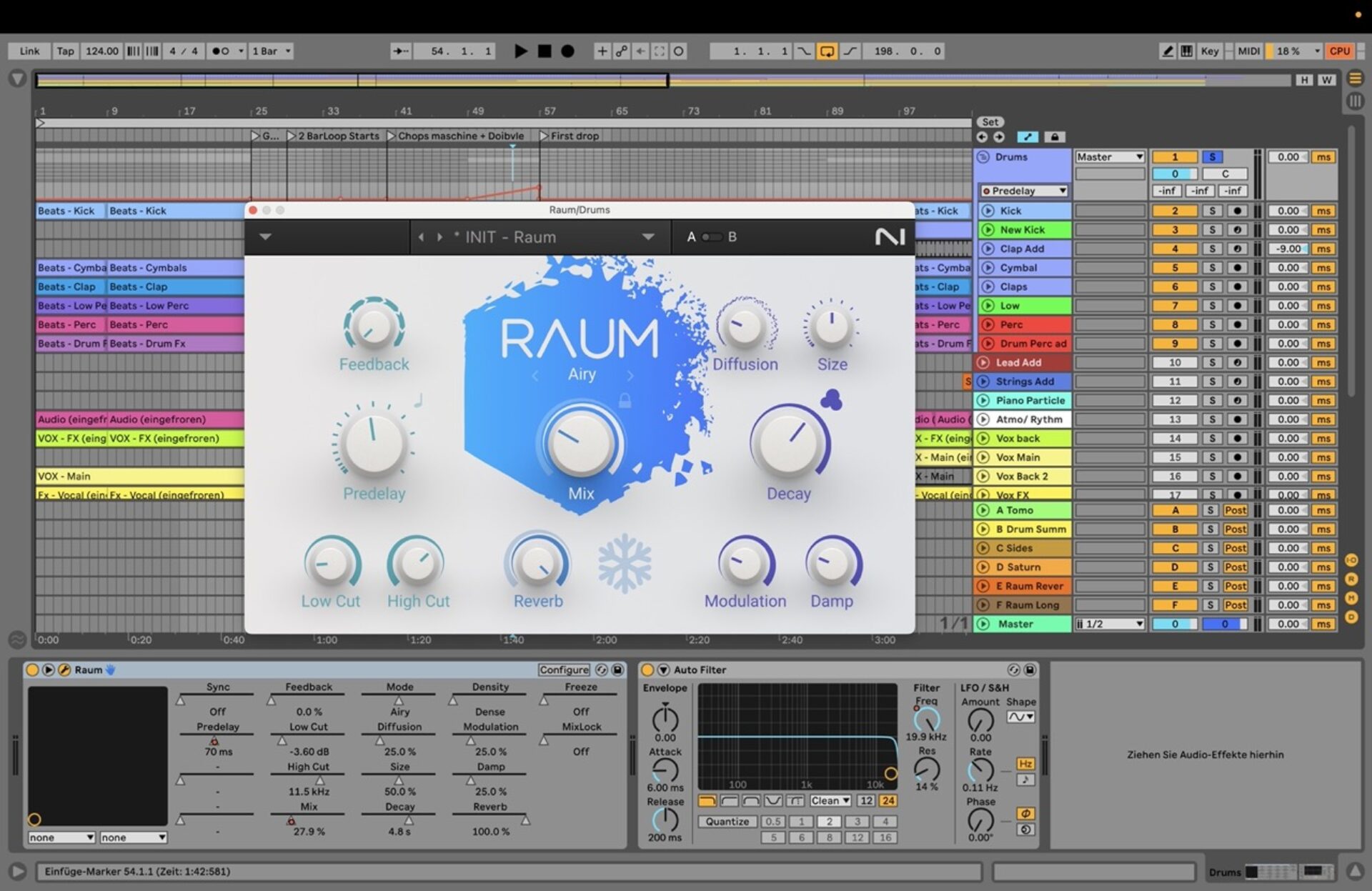
For bigger gestures, I’ll capture a chord tail or a vocal consonant into freeze on the Atmos/Drones bus, then play over that sustained field. Because Raum is optimized for smooth switching and freeze behaves musically, I can shape that pad by riding size without clicks or noise. It’s perfect for lifting a chorus or intro with drone-like textures.
After that, there’s a sidechain. I keep low cut around 150–200 Hz and high cut between 8–12 kHz, so the pad supports the mix instead of competing with it.
Pro tip from Felix Raphael: Use freeze as an instrument. Put freeze on a momentary button to catch the end of a phrase and perform over an infinite bed. It’s designed for smooth transitions and responds beautifully in live control.
Why bring Raum into your live setup, and how do you keep it reliable?
The theme of my album DO YOU lives at the intersection of doubt, healing, and fulfillment. Emotions that can feel different every night. I wanted a reverb that I could play in real time, rather than just set and forget.
That doesn’t mean there is no reverb in my backing tracks. I just think that having a live reverb such as Raum is an excellent way to set the mood. It’s an ambient instrument to play in the quieter parts of songs. I use freeze to set the tone or short decay times to wash out the whole mix in the break before the drop. That makes it really impactful when everything gets tight and punchy again.
Reliability is mostly about architecture and restraint. I only run Raum on returns, keeping my CPU headroom generous. Mapping is simple and range-limited, so I can’t accidentally flood the mix in an adrenaline moment. Raum is designed to respond well to real-time control, which makes it a good partner for performance.
Regarding the freeze function, I have an automated “Freeze Off” control over the IAC Driver at the end of each track.
Pro tip from Felix Raphael: Work with a two-return method. Use a short Grounded return for presence and a longer Airy or Cosmic return for lift. Crossfade between returns rather than switching algorithms mid-line.
How does Raum help reflect the emotional shifts in DO YOU live?
Absolutely. The record moves from struggle to fulfillment to balance. I use Raum’s algorithms to paint that journey in space. Grounded gives me intimacy and honesty for fragile phrases. Airy opens into hope, letting phrases bloom. Cosmic bends time and place for those surreal moments where everything feels suspended. The spaces Raum creates frame the lyrics at the exact right moments.

That doesn’t necessarily mean I’m using Raum primarily for vocals. It helps me to set the tone of a song in different ways.
The freeze function is especially expressive here. Because freeze can hold the reverb content musically, I can ride the scene in real time. Especially before a drop – you know these “hands in the air” moments after a long build-up. Raum lets me stay in that moment as long as I like. Then I can narrow the shape or even the stereo field, leading right into the drop.
Pro tip from Felix Raphael: Protect clarity with pre-delay: 20–60 ms keeps transients and consonants up front while the space blooms behind.
How do you set up Raum for big vocal shifts without losing control live?
When I perform live I work with a sound engineer who has control over my vocals. They usually keep my vocal processing reverb rather short.
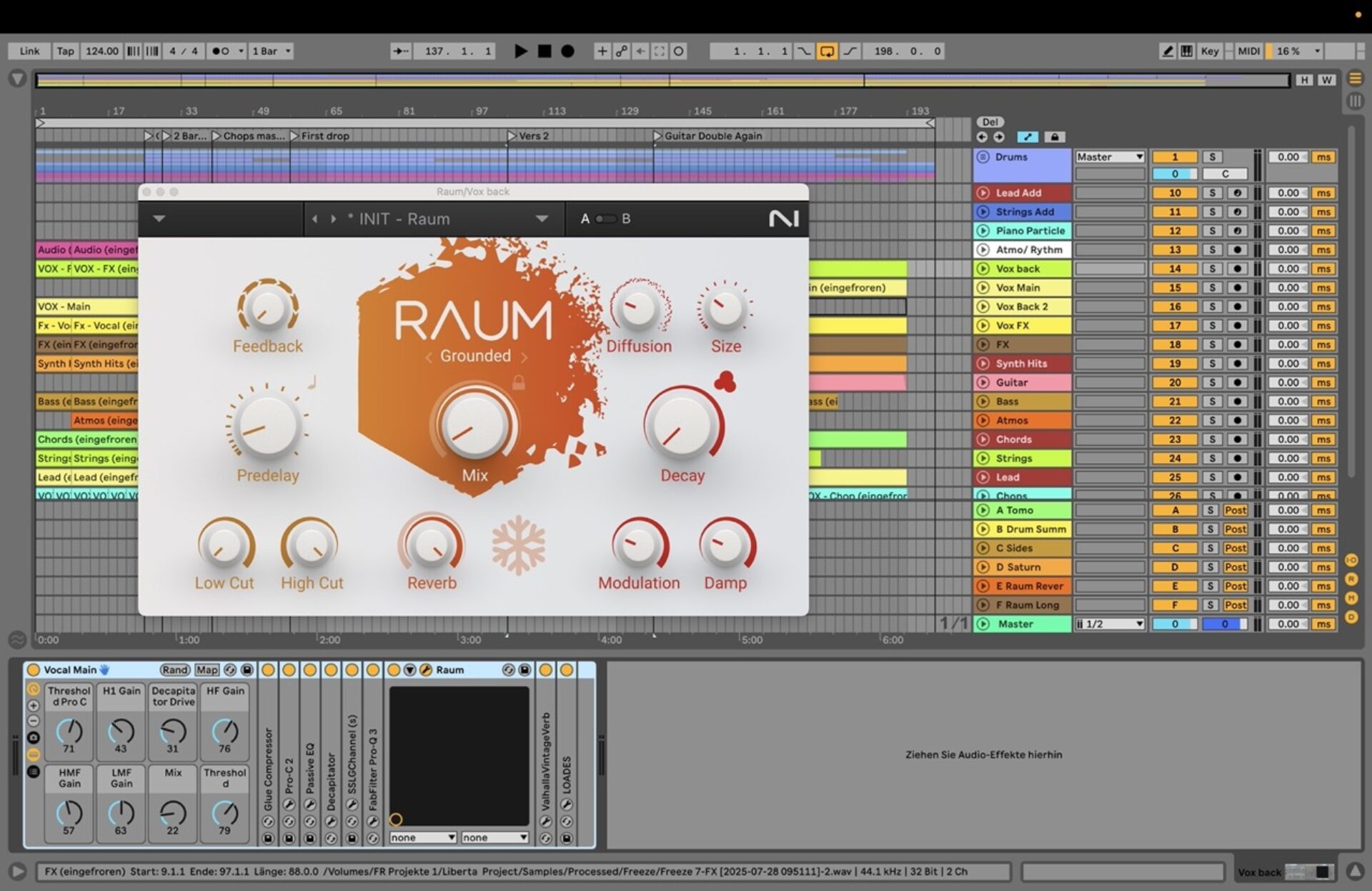
What I also do for parts – like the one in Creation that you mentioned – is that I add a second reverb on top. The second instance of Raum would have a different algorithm, pre-delay, and decay setting. That prevents things from being totally cut off when I turn down the knob. It’s also important to set up a sidechain from the vocal on the reverb. That stops the reverb from washing out the vocal too much.
Pro tip from Felix Raphael: Range-limit your mappings. Cap the minimum and maximum settings so adrenaline doesn’t push you into swampy territory on stage.
How do you know when to leave reverb alone during a set?
It’s important to decide the reverb arc before the show. You’ve also got to show a bit of restraint. If the lead information, like lyrics or transients, starts to blur, that’s the cue to leave your reverb alone. Mix around the existing space rather than adding more of it. Range limits on mix and decay help a lot – they keep you from painting yourself into a corner mid-set.

I also recommend thinking in negative space. If the room is already carrying emotion, use dynamics and phrasing to dance with it. Often, the boldest move is no move. Let the space speak and resist the temptation to chase every swell with more reverb. That discipline reads as confidence to the audience and gives your biggest lift somewhere to go.
I’m still learning the importance of this, but less can definitely be more. Silence can be so powerful.
Pro tip from Felix Raphael: Filter your tails. A low cut around 150–200 Hz and a high cut around 8–12 kHz will keep pads warm and supportive instead of fizzy or muddy.
What advice would you give on balancing hardware and software live?
Build the rig around your hands. I’ve already tried so many different setups with different gear and placements, and I probably will continue to do that. I kind of like it, but you should definitely practice enough before every gig.
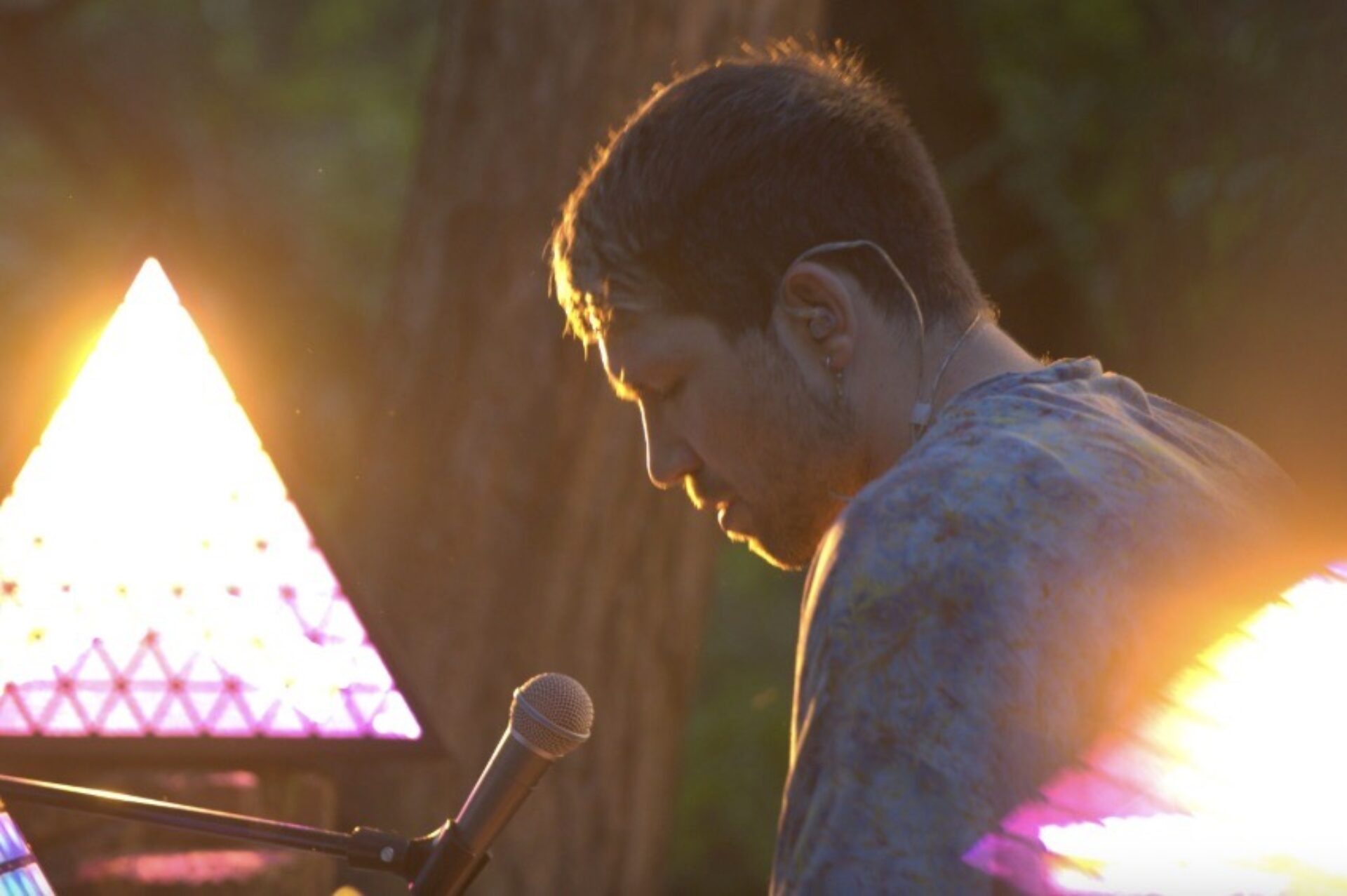
My biggest change was to get rid of the DJ-like table right in front of me. I opened my setup and that opened up the stage. It made it feel like I had a band on stage with me, and the audience was right there in front of us.
That made a huge difference because I was suddenly close to the people, and the energy felt different. Using a table is understandable because it’s a safe space where you can hide. But it takes away freedom on stage. Opening things up feels and looks different. Let the audience see and feel your craft. It makes for a better performance.
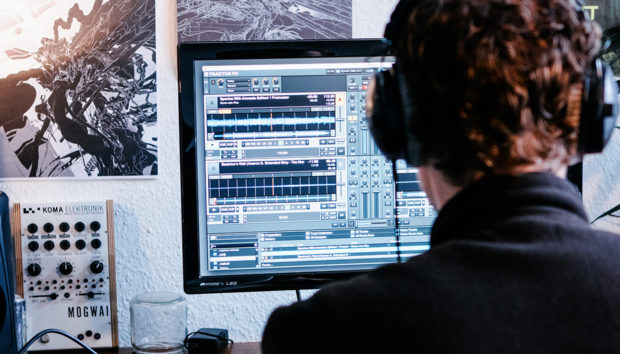
Real instruments, like a guitar or piano, are fantastic. These give you and your audience physical intention. Software like Raum frames that intention in space. Clear roles keep the setup musical instead of menu-driven. And, of course, everything is controlled by the mothership DAW. That’s a really critical bit of software for a live set.
Prioritize stability over features. Fewer, better-mapped instances on returns beat a forest of inserts. Keep CPU headroom, trim background processes, and print critical transitions as safety nets. That way, when you do take risks in the moment, the system is “boring” in the best possible way. That lets the audience hear the art, not the architecture.
Pro tip from Felix Raphael: Keep returns, keep headroom. Run Raum on returns, not inserts, to leave CPU margin.
Wrapping it all up
DO YOU is a performance-driven album that adapts to the energy in the room. Raum provides the tools Felix needs to shape reverb as part of the arrangement, not as a background detail.
Each element in the rig serves a specific role. Returns carry the space, macros handle transitions, and careful filtering keeps the tone clear. The decisions behind the setup are rooted in practice, stability, and emotional control, creating space for the performance to move without relying on automation. The goal is not to impress with complexity, but to create a setup that supports consistency and fluid control night after night. Felix uses the same restraint in his gear that he does in his arrangements, letting intention drive every choice.
Related articles
-
Behind the synth: A. G. Cook on stacked sawtooths and the creation of Super*Saw
Explore the extremes of stacked sawtooth waves with Super*Saw, a new synthesizer co-created with A. G. Cook. Learn how to…
-

Inside the evolution of orchestral sampling: an interview with ProjectSAM
Discover how ProjectSAM’s Lineage Series uses NKS and smart features to change orchestral sampling. Plus, save on instruments in our…
-

How New Constellations turn emotion into sound with Massive X
Go inside the studio with New Constellations. Learn how they use Native Instruments gear, happy accidents, and lifelong friendship to…
-
Citizen Kain on building emotion and space with Replika
Citizen Kain explains how Replika helped shape the rhythm, tension, and emotion behind his debut Eversun Records single “Moments.”…
-

The organic precision behind Calcou’s Anjuna release featuring Reaktor
Calcou shares how Reaktor, Monark, and Super 8 shaped the creative balance and live energy behind their new duo EP,…
-

14 NKS instruments that will change the way you create music
Discover 14 NKS instruments to freshen up your workflow. From lo-fi tape synths to cinematic strings, shop the Native Instruments…
-
Parallelle on crafting living basslines with Reaktor and TRK-01
Parallelle share how Reaktor and TRK-01 shape the bass and warmth in 11th Avenue, balancing analog depth with modern control.
-
Where will your sound lead you? Explore the Native Instruments Summer Sale
Save 30% on instruments, effects, and sounds in our Summer Sale. Find the tools to keep your tracks moving and…