
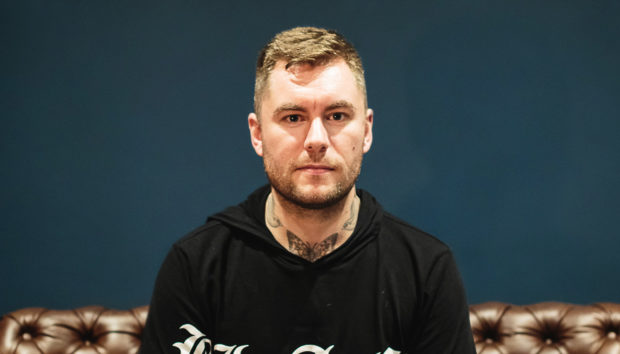



London-based producer and Fabric resident Hardt Antoine built his new single “Let Me Go” around a sense of movement and control. Released on Kompakt, the record carries a focused rhythmic core that feels both deliberate and spontaneous.
For Antoine, the secret lies in how quickly he can move from idea to execution. Maschine plays a key role in that process, allowing him to shape samples, test grooves, and build emotion through rhythm rather than polish.
His approach to production favors limitation and instinct.
The fewer steps between an idea and its expression, the better the track tends to flow. Maschine gives him that speed, functioning as a direct connection between thought and sound. It keeps the workflow tactile, encourages experimentation, and helps capture moments that feel unplanned but musical.
Jump to these sections:
- How ideas begin in the studio
- Using Maschine to find groove and texture
- Capturing energy in “Let Me Go”
- Embracing accidents in the sampler
- Staying focused with hardware
- Trusting instinct and imperfection
In this interview, Antoine explains how hardware shapes his creativity, how he uses envelopes to define groove, and why learning to commit early has become essential to finishing his best work.
When you first sit down in the studio, what usually sparks an idea? Do you start rhythm-first, or chase a melodic idea?
There are really no rules or set processes. I just like to move quickly at first to cycle though ideas and get creative juices flowing.
If I am in melodic headspace, I could load a sine-wave synth or basic piano and start playing through a midi keyboard, draw notes on the piano roll or often a mix of both. I usually find it easier to use simple sounds to develop the melodic ideas, so I can focus on sound design after.

Another common starting point is dropping a sample into Maschine. I have a workflow of using the sampler to scroll through the sample to find cuts I like and copy/pasting the ones that tickle me onto their own pads. Before I knew it I had a Maschine ‘kit’ of chops. It works for vocals, drums, melodies, textures – anything really, and it’s very quick.

Pro tip from Hardt Antoine: Use the ADSR and AHR in Maschine envelopes to shape sounds so they are the right length. It gets them talking to each other faster.
How central is Maschine in that early stage when you’re searching for a groove or texture?
I generally use Maschine when I want a human/real flavour to my grooves. I can get something going very quickly with percussion talking to each other. Maschine is good when I want to play something in – usually simpler, musical percussive grooves layered that I can get talking to each other.

I also find it the quickest tool for chopping up samples as mentioned above, especially long vocal lines.

Pro tip from Hardt Antoine: Copy full sample into its own drum pad before chopping. That way you can edit, truncate and normalise to make the sample more manageable, and easily ‘go back’ if you over edit.

When working on “Let Me Go,” how did Maschine help you capture the raw energy without polishing it away?
I used it to create the base of the groove – the kick, the tom and hi-hat. Simple yet musical rhythms that anchor the track.

Something I really love about Maschine is the built-in ADSR envelope into every sample. It means you can shape the sound very quickly, so they’re just the right shape in production. It means minimal mixing is required later. To be honest since discovering this workflow I’ve become dependent on it and now I find it hard to work with samples without envelopes at the ready.

It also has an AHR (Attack, Hold Release) envelope which is intuitive for drums. I wish more plugins and machines had this option.
Were there any sounds or performances in “Let Me Go” that came from happy accidents or unexpected Maschine sessions?
I move very quickly when chopping up vocals, or anything in Maschine.

The chopped syllables at the end of the vocal pattern are a big part of the hook to me. It wasn’t something I expected hearing the initial vocal but was discovered though chopping quickly in the sampler and finding those sharp, consonant moments I wouldn’t have otherwise.
Is that a happy accident? I think I’m used to looking for these moments now, playing with randomness and keeping an open mind.
Pro tip from Hardt Antoine: I use one group for each sample I chop, I find spreading out makes the project easier to visualise.
Do you find that using hardware helps you focus creatively in a way software alone doesn’t?
Yes. I generally don’t like searching through presets and samples on a screen. Something about cycling through drums on Maschine is really satisfying – maybe because there is no lag once they have been imported.

I’m mostly using hardware to start off tracks, playing synths, using samplers, even playing with midi controllers for plugins. It feels more musical. I go in the box for details later on.
I have a few hardware machines but I know them very well so I’m very fast. It means I can work very quickly with my not ‘small’ but still limited setup. In-the-box there are endless possibilities, which means things can take a lot longer and creative juice can fizzle. I think it’s part of the reason I can get musical ideas out very quickly but it can take a long time for me to be happy with a polished track.
Looking back, what did “Let Me Go” teach you about trusting instinct and letting hardware guide the creative process?
Using hardware I find there is less temptation to tweak forever. There is also an element of committing once it is exported. It will never be perfect, it’s not supposed to be. That imperfection is part of what makes a production sound musical.
Pro tip from Hardt Antoine: Import your regular and favourite sounds into Maschine, it makes loading them much faster.

Wrapping it all up
Hardt Antoine’s process revolves around efficiency, focus, and instinct. Maschine sits at the center of that mindset because it supports movement instead of hesitation. It keeps rhythm creation physical and spontaneous while providing enough control to shape every sound on the spot.
“Let Me Go” shows how small workflow details can lead to large creative payoffs. Antoine’s ability to translate feeling into rhythm depends on staying close to the tools he knows best. Each decision is driven by touch, timing, and trust in the process.
In a scene often defined by endless digital choices, his setup proves that clarity comes from limitation. The more he lets hardware define the boundaries, the faster his ideas take shape.
Related articles
-
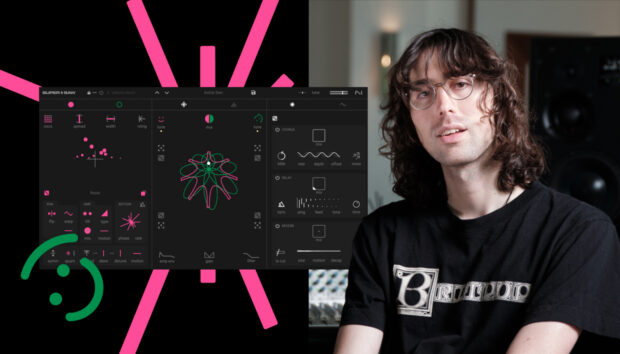
Behind the synth: A. G. Cook on stacked sawtooths and the creation of Super*Saw
Explore the extremes of stacked sawtooth waves with Super*Saw, a new synthesizer co-created with A. G. Cook. Learn how to…
-

Inside the evolution of orchestral sampling: an interview with ProjectSAM
Discover how ProjectSAM’s Lineage Series uses NKS and smart features to change orchestral sampling. Plus, save on instruments in our…
-

How New Constellations turn emotion into sound with Massive X
Go inside the studio with New Constellations. Learn how they use Native Instruments gear, happy accidents, and lifelong friendship to…
-
Citizen Kain on building emotion and space with Replika
Citizen Kain explains how Replika helped shape the rhythm, tension, and emotion behind his debut Eversun Records single “Moments.”…
-

The organic precision behind Calcou’s Anjuna release featuring Reaktor
Calcou shares how Reaktor, Monark, and Super 8 shaped the creative balance and live energy behind their new duo EP,…
-

14 NKS instruments that will change the way you create music
Discover 14 NKS instruments to freshen up your workflow. From lo-fi tape synths to cinematic strings, shop the Native Instruments…
-
Parallelle on crafting living basslines with Reaktor and TRK-01
Parallelle share how Reaktor and TRK-01 shape the bass and warmth in 11th Avenue, balancing analog depth with modern control.
-
Where will your sound lead you? Explore the Native Instruments Summer Sale
Save 30% on instruments, effects, and sounds in our Summer Sale. Find the tools to keep your tracks moving and…