




Dutch producer Huminal has built a reputation for melodic house and techno that balances clarity with emotion. His latest collaboration with Mitch de Klein, Mirage, released on Purified Records, achieves this balance through meticulous sound design and a strong sense of spatial depth. Each layer feels intentional, from the bass weight to the airy movement in the chords, creating a space that feels alive without ever feeling crowded.
For Huminal, the secret sits in the tools that shape his sound. Raum became a defining part of his workflow while working on Mirage, allowing him to build space that supports melody and movement rather than overwhelming them. His use of reverb goes beyond simple ambience and becomes part of the composition itself, giving each sound its place and dimension in the mix.
In this interview, Huminal explains how Raum helped shape Mirage, his approach to atmosphere as an expressive tool, and the small details that make a mix feel immersive.
Jump to these sections:
- How Huminal used Raum to shape Mirage and create its immersive depth
- Why Raum became more than an effect and part of the creative process
- Translating atmosphere across systems
- Tips for balancing reverb, space, and drive in melodic house
- Atmosphere as artistic identity
- Defining the role of space
Discover why a great reverb can be one of the most powerful tools in electronic music by getting Raum free in the Komplete Start bundle.
Mirage has such a strong sense of space. When you start a track, do you already know how you want the atmosphere to feel, or does it take shape as you design sounds?
No, I usually don’t start a track with a specific atmosphere in mind. It all begins with a melody or theme, and from there, I build the atmosphere and space around it. For the title track of the EP, we devised a remarkably epic chord progression, so we wanted to give it ample depth and space in the mix to create that ethereal feel.
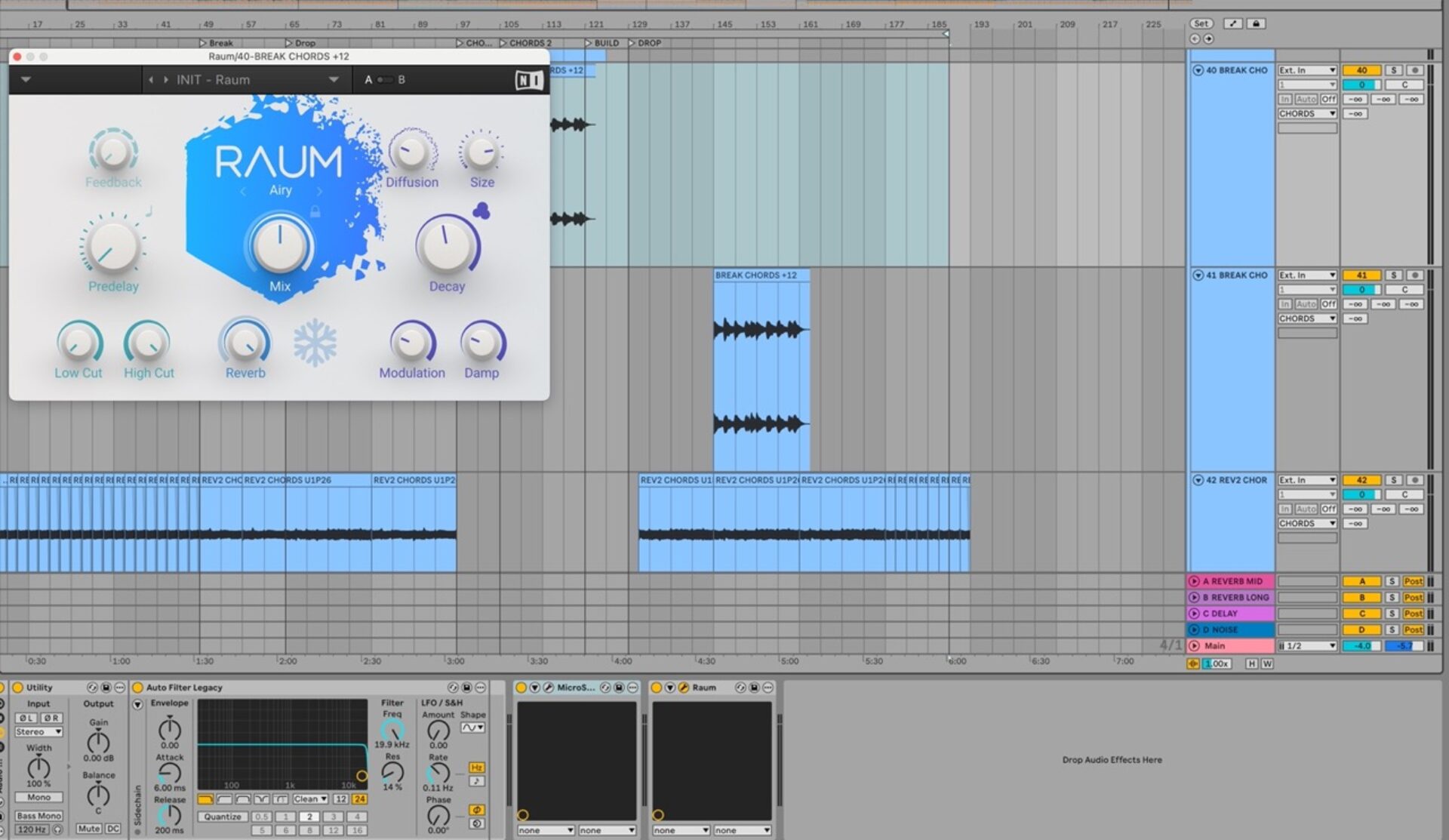
We used Raum a lot on Mirage. It’s such an incredible-sounding reverb. I had it as part of my Komplete bundle, but only really discovered it during my studio sessions with Mitch. Since then, it’s found its way into almost every project I work on.
That said, it’s not just the reverb that gives the chords their size. They’re also layered with a basic sawtooth, with the unison turned up quite a bit, which really helps make the progression sound wide and powerful.
Pro tip from Huminal: Before you buy any new synths or effects, take a look at what you already have but haven’t been using. There could be some hidden gems in there.
Do you treat reverbs and delays as effects in your workflow, or do you think of them more as instruments that need their own space in the mix?
It really depends on how much the effect changes the sound, but I always try to be aware of the space each element occupies in the mix. For example, if it’s a pad that mainly supports a lead and doesn’t need to take the spotlight, I usually push it back a bit in the mix, often adding reverb directly on the channel rather than with a send.
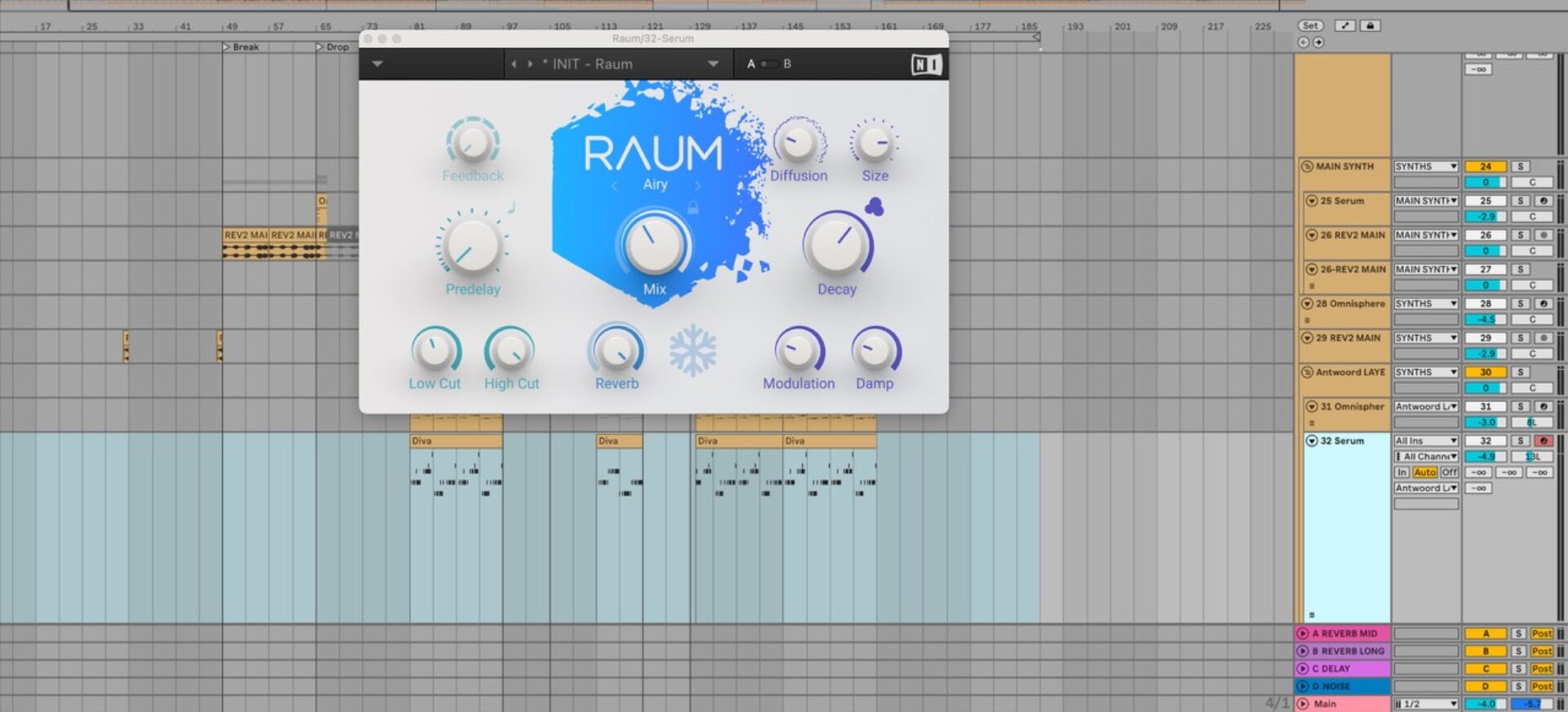
For a lead sound that needs to stand out, I typically use a send for the reverb. That way, the lead stays upfront and clear, but still gets some depth and space behind it.
How do you test your mixes to ensure the immersive qualities translate across various club systems, headphones, and smaller speakers?
I usually listen to the mix on different sound systems: my studio monitors, headphones, iPhone speakers, and in the car. This helps me hear how the energy and immersive qualities of the track translate across various environments, and I make adjustments accordingly.

Testing tracks in clubs is a bit trickier, since I don’t usually stand in the crowd when I play my own music. I often ask a DJ colleague or fellow producer to check how it sounds on the dancefloor and share their feedback. Monitor speakers can give you an idea, of course, but ultimately you want to know how it translates on the main system.
One thing I constantly check when producing is how everything sounds in mono. This is a great way to ensure all the key elements still stand out, especially on a big sound system.
Pro tip from Huminal: Set a mono shortcut on your sound card or keyboard so you can quickly toggle between mono and stereo, ensuring everything translates well.
What advice would you give younger producers who want to add depth and space to their tracks without losing energy on the dancefloor?
As I said, keep checking your mix in mono while producing. It’s the quickest way to ensure your main elements stay solid and don’t get lost on larger sound systems.
Be cautious with reverb. It can add a lot of energy, but it can also consume headroom and blur important details. There are plenty of ways to create depth. Delays, subtle unison layers, or creative panning can also do the job.
Pro Tip from Huminal: Set your reverb times to match the track’s BPM. On drums, this prevents the reverb from smearing into the next kick, and keeps your rhythm tight.
Do you feel like atmosphere can act as an identity marker for an artist?
I think it definitely can, and there are lots of producers who do so, but I wouldn’t really say it’s something that’s always the same in my work. So it’s not exactly a trademark of my productions. For me, the lead melody or theme is always the driving force, and the atmosphere around it should support and enhance that.

Sometimes I want to create big, energetic tracks like “Mirage,” but at other times, I aim for a more emotional track that feels intimate, vulnerable, or introspective. Then the focus is on subtlety and the emotions it evokes rather than sheer energy. It really depends on the story I want the track to tell.
Looking back then, what exactly is atmosphere to you?
I see atmosphere more as a tool than a defining label. For me, it’s about creating a journey in each record rather than chasing a specific “sound.”
I focus on how space, depth, and texture can enhance the emotional impact of a track, whether it’s a driving track like “Mirage” or a more introspective moment. In that sense, atmosphere serves to convey the emotion I want to express, rather than defining my career or style outright.
Pro Tip from Huminal: Before reaching for reverb, try panning your elements first. It can give space and clarity in the mix without washing out the sound.
Wrapping it all up
Mirage captures what makes Huminal’s approach so distinct: a focus on balance between melody and movement, emotion and precision. Raum helped him explore that space, adding texture and width without losing clarity.
For Huminal, sound design is a form of storytelling. Raum’s versatility gives him the space to build those stories in detail, from deep, reflective passages to open, uplifting builds. The result is a sound that feels immersive yet deliberate, always serving the emotion of the track.
Related articles
-
Behind the synth: A. G. Cook on stacked sawtooths and the creation of Super*Saw
Explore the extremes of stacked sawtooth waves with Super*Saw, a new synthesizer co-created with A. G. Cook. Learn how to…
-

Inside the evolution of orchestral sampling: an interview with ProjectSAM
Discover how ProjectSAM’s Lineage Series uses NKS and smart features to change orchestral sampling. Plus, save on instruments in our…
-

How New Constellations turn emotion into sound with Massive X
Go inside the studio with New Constellations. Learn how they use Native Instruments gear, happy accidents, and lifelong friendship to…
-

Citizen Kain on building emotion and space with Replika
Citizen Kain explains how Replika helped shape the rhythm, tension, and emotion behind his debut Eversun Records single “Moments.”…
-

The organic precision behind Calcou’s Anjuna release featuring Reaktor
Calcou shares how Reaktor, Monark, and Super 8 shaped the creative balance and live energy behind their new duo EP,…
-

14 NKS instruments that will change the way you create music
Discover 14 NKS instruments to freshen up your workflow. From lo-fi tape synths to cinematic strings, shop the Native Instruments…
-
Parallelle on crafting living basslines with Reaktor and TRK-01
Parallelle share how Reaktor and TRK-01 shape the bass and warmth in 11th Avenue, balancing analog depth with modern control.
-
Where will your sound lead you? Explore the Native Instruments Summer Sale
Save 30% on instruments, effects, and sounds in our Summer Sale. Find the tools to keep your tracks moving and…